Category: Booklets

  • Reading the comments on the booklets

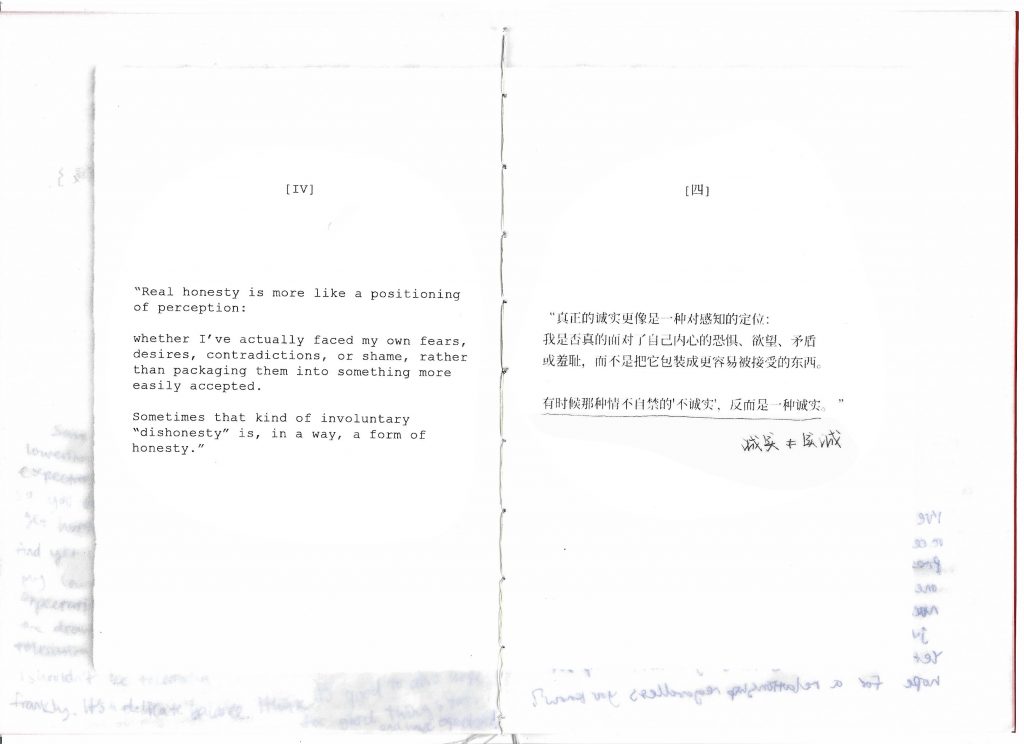
    Two booklets were out for one week. Together they hold 30 written comments, 18 in English and 10 in Chinese. And the following are some points and phenomena I have recognized.

    “Same, but…”

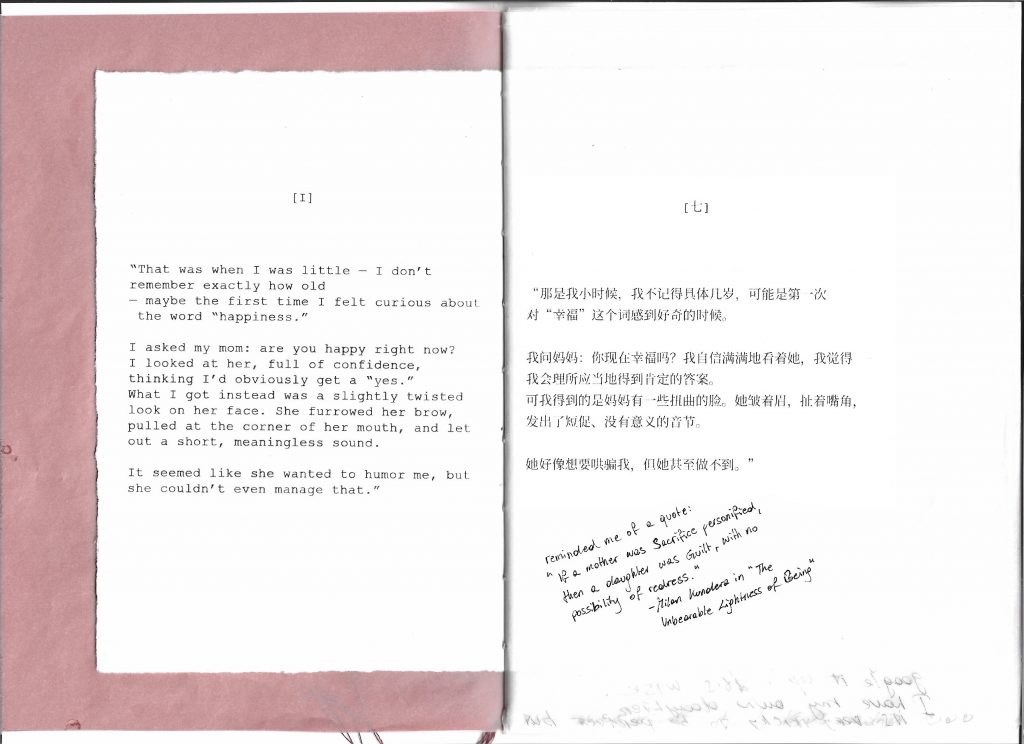
    Most readers recognised a quote and then added a counterweight. The tension sits inside the reader as much as between the reader and the culture around them. Nobody blamed their mother or anyone else. They described a balance they are still working out.

      Readers brought their own frames

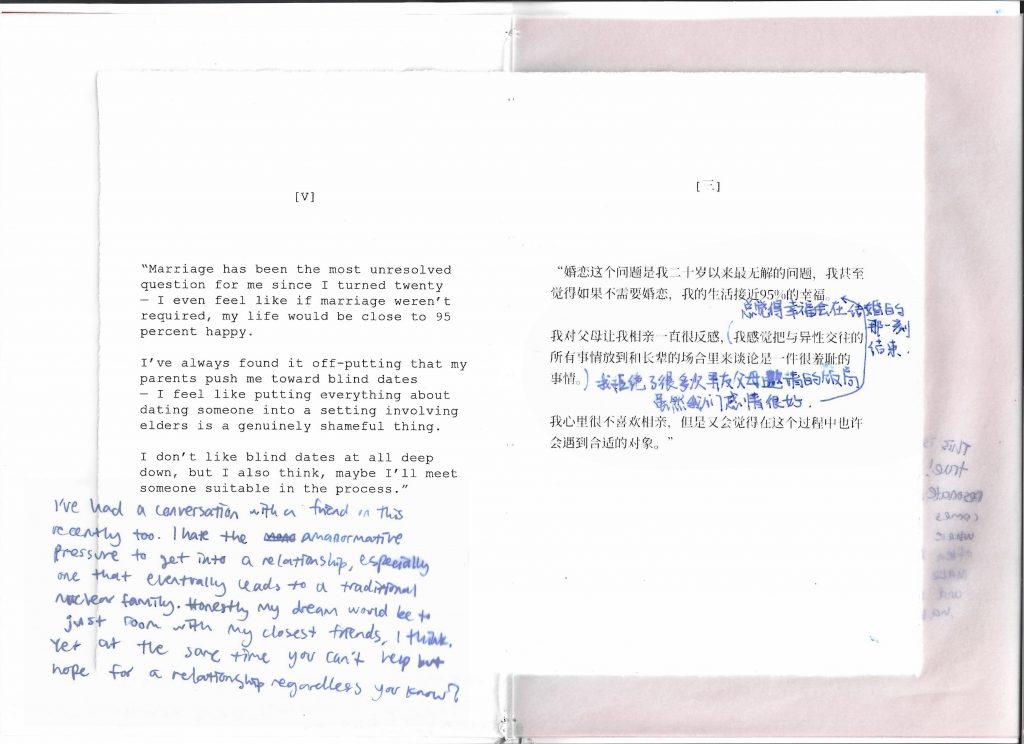
      Kundera, “good enough parent” and “amatonormative” were not in the booklets. A reader supplied them.

      Concrete beats abstract

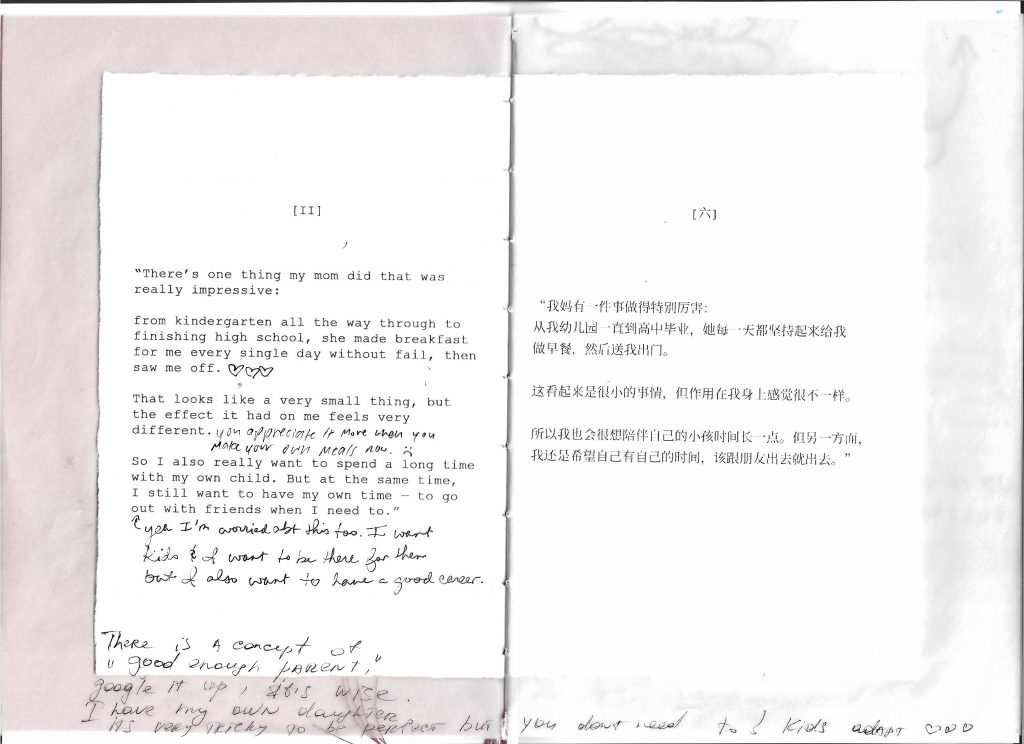
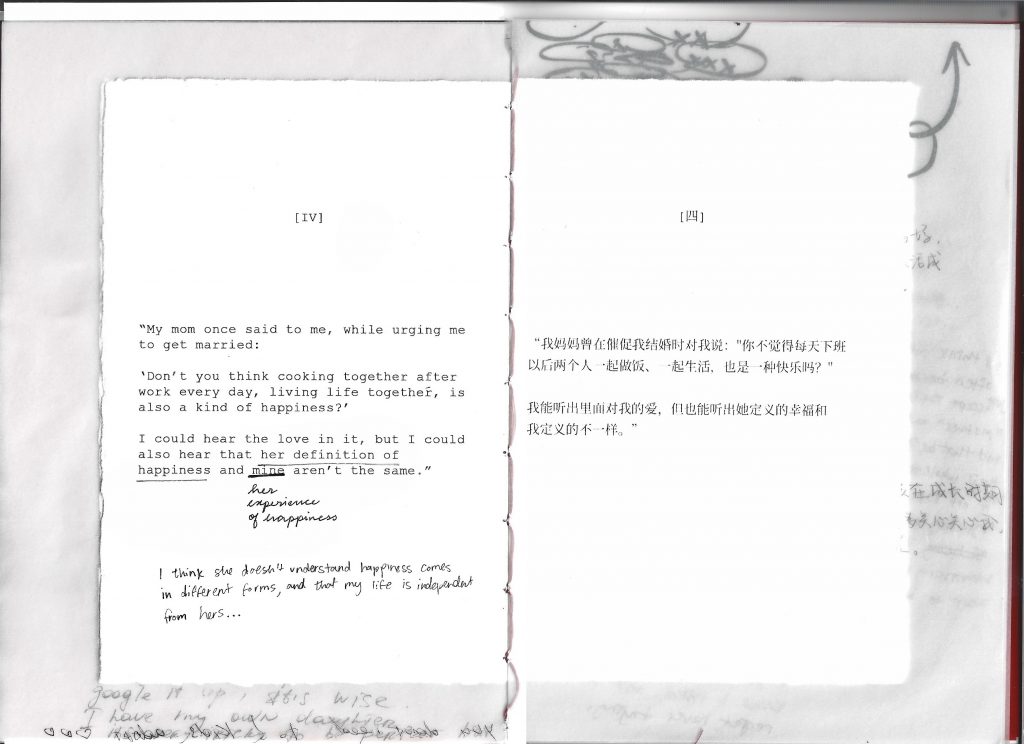
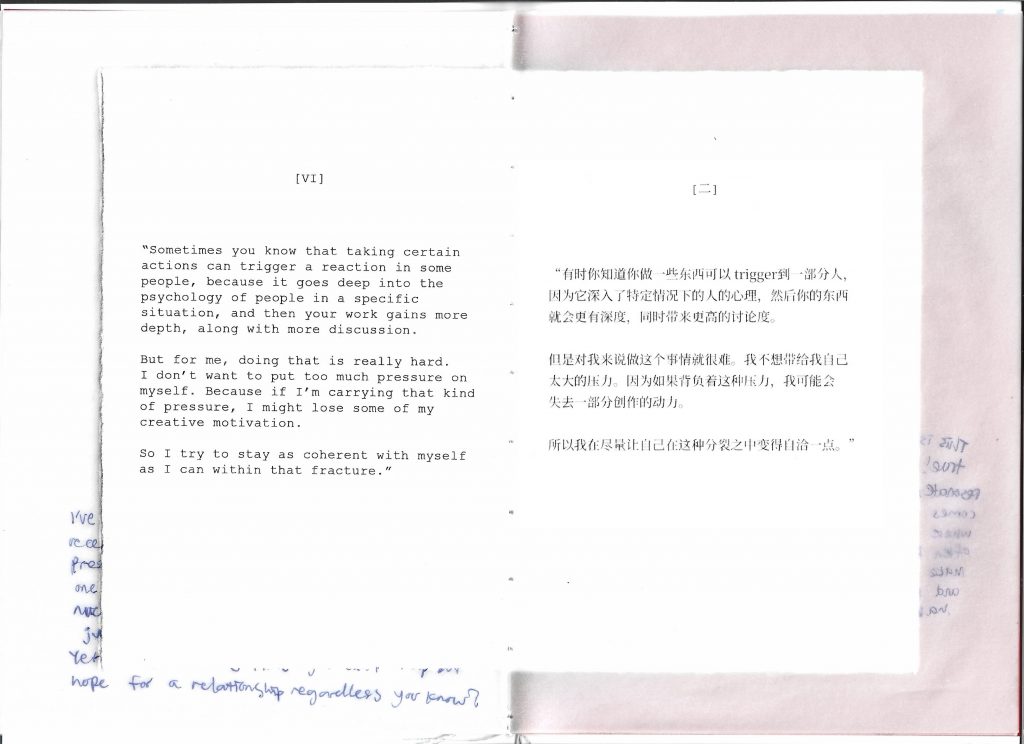
      Quotes about a specific scene (the daily breakfast, my mother’s line about cooking together after work, blind dates) drew the most writing. Abstract ones (honesty, triggering others while staying coherent) drew almost none. This matches what happened on Threads, where my personal-experience post got far more response than the post asking for a definition.

      English and Chinese comments feel different

      Length is the obvious difference, but there is more.

      English comments were often addressed to someone: to the “author” (“I completely understand”), or to another reader (“Agree”, “I disagree”). Also, all of the exchanges between readers are in English.

      Chinese comments mostly read as statements to no one, such as “总觉得幸福会在结婚的那一刻结束( I always feel that happiness ends the moment you get married.)” or “我拒绝了很多次男友父母邀请的饭局,虽然我们感情很好。( I’ve declined my boyfriend’s parents’ dinner invitations many times, even though we have a great relationship.)”.

      Plus, the Chinese comments never gave advice, while a few English ones did. This could reflect a cultural reluctance to instruct, but Chinese-language Threads comments do instruct, so it may instead depend on the setting, or on how close each reader is to the experience. I can’t separate these with 30 comments.

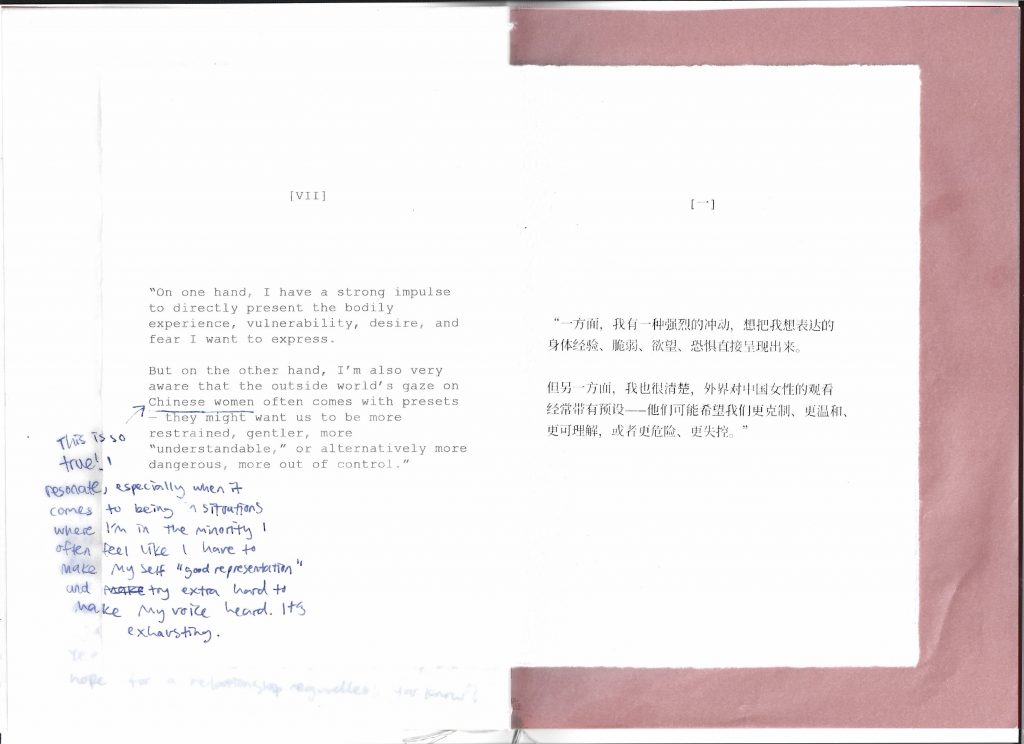
      One comment about being watched

      A reader wrote that as a member of a minority she feels she has to be “good representation”, and that it is exhausting. It answers the quote about the outside gaze on Chinese women, but she framed it as minority status, not Chinese womanhood. This raises the question of whether the fracture is specific to Chinese women or shared by people in a watched position.
    1. Comments documentation-SELF / FISH / LOVE / SACRIFICE / PROTECTION / DOUBT…

      PageQuote (short)LangReader’s comment
      StatementOpening statementEN / 中“like this!”
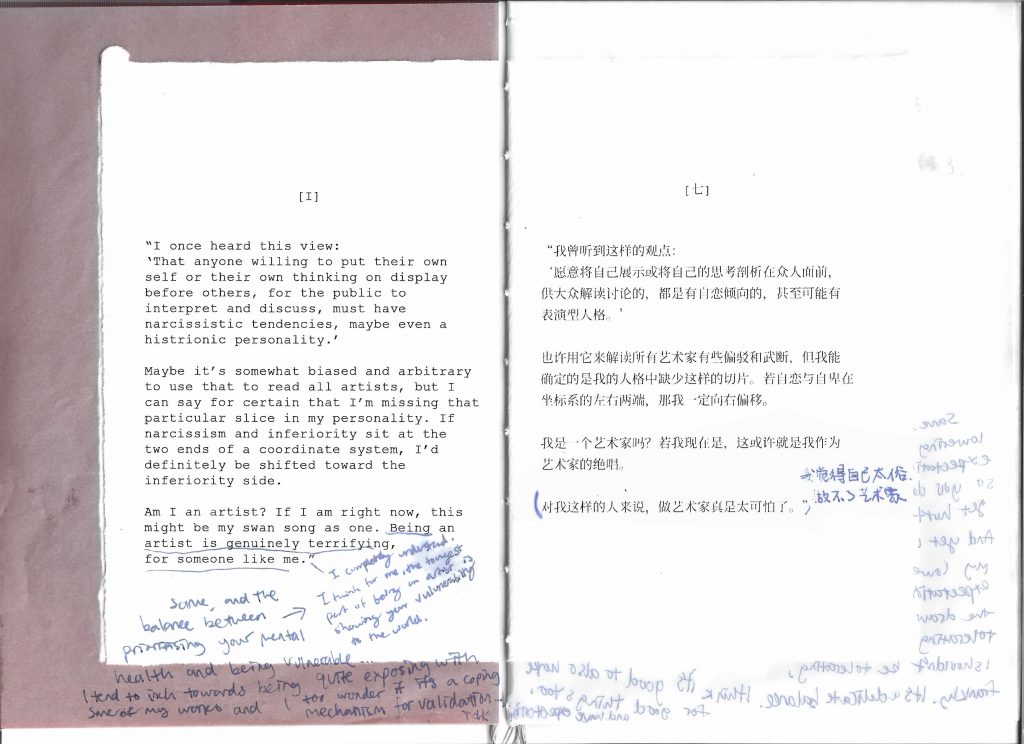
      IBeing an artist is terrifying, for someone like me (narcissism and inferiority)EN“Same, and the balance between prioritising your mental health and being vulnerable… I tend to inch towards being quite exposing with some of my works and I too wonder if it’s a coping mechanism for validation…”
      IEN“I completely understand. I think for me, the toughest part of being an artist is showing your vulnerability to the world.”
      七中“我觉得自己太俗,做不了艺术家。” / “I think I’m too mundane to be an artist.”
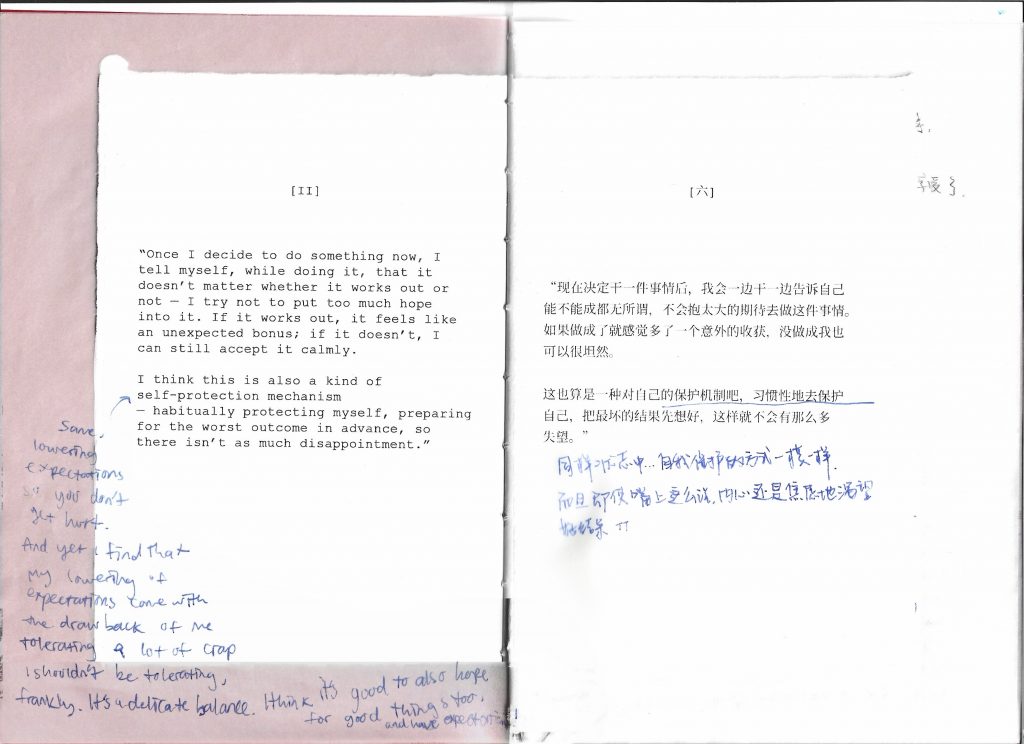
      IILowering expectations as self-protectionEN“Same, lowering expectations so you don’t get hurt. And yet I find that my lowering of expectations come with the drawback of me tolerating a lot of crap I shouldn’t be tolerating, frankly. It’s a delicate balance. I think it’s good to also hope for good things too, and have expectations.”
      六中“同样状态中……自我保护的方式一模一样。而且即使嘴上这么说,内心还是焦虑地渴望着结果 TT” / “In the same state too… my way of protecting myself is exactly the same. And even though I say this out loud, deep down I still anxiously long for the result TT”
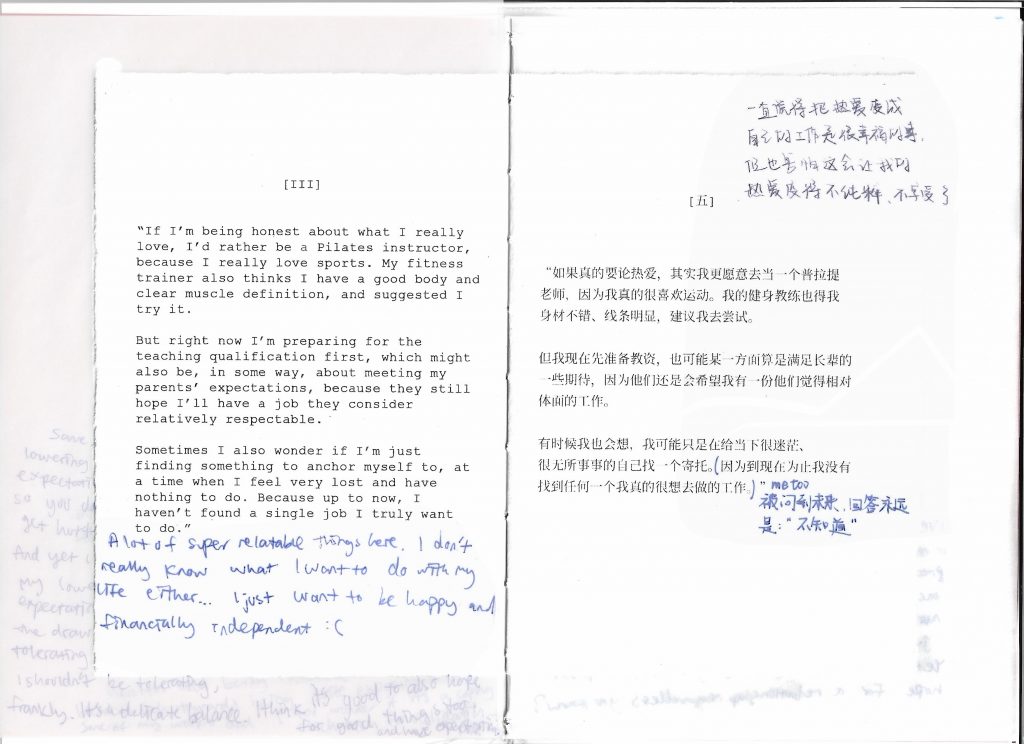
      IIIPilates, the teaching qualification, no anchorEN“A lot of super relatable things here. I don’t really know what I want to do with my life either… I just want to be happy and financially independent :(“
      五中“一直觉得把热爱变成自己的工作是很幸福的事,但也害怕这会让我的热爱变得不纯粹、不享受了。” / “I’ve always thought that turning what you love into your job is a happy thing, but I’m also afraid it would make my passion less pure and less enjoyable.”
      五中“me too,被问到未来,回答永远是:’不知道’。” / “Me too. When I’m asked about the future, my answer is always ‘I don’t know.’”
      IV / 四Honesty and involuntary dishonesty中“诚实 ≠ 实诚” / “Honest ≠ 实诚 (shicheng: being straightforward and blunt)”
      VMarriage; blind dates are shamefulEN“I’ve had a conversation with a friend on this recently too. I hate the amatonormative pressure to get into a relationship, especially one that eventually leads to a traditional nuclear family. Honestly my dream world would be to just room with my closest friends, I think. Yet at the same time you can’t help but hope for a relationship regardless you know?”
      三中“总觉得幸福会在结婚的那一刻结束。” / “I always feel that happiness ends the moment you get married.”
      三中“我拒绝了很多次男友父母邀请的饭局,虽然我们感情很好。” / “I’ve turned down my boyfriend’s parents’ dinner invitations many times, even though we get on very well.”
      VI / 二Triggering others; staying coherent within the fractureNo comments
      VIIImpulse to present vs the outside gaze on Chinese womenEN“This is so true! I resonate, especially when it comes to being in situations where I’m in the minority I often feel like I have to make myself ‘good representation’ and try extra hard to make my voice heard. It’s exhausting.”
    2. Comments documentation-Daughters and Mothers

      PageQuote (short)LangReader’s mark or comment
      IAsking mum if she is happy; her twisted faceEN“If a mother was sacrifice personified, then a daughter was guilt, with no possibility of redress.” (reader attributes it to Kundera, The Unbearable Lightness of Being; not verified)
      IIMum’s breakfast every dayENHearts
      IIEN“you appreciate it more when you make your own meals now :(“
      IIEN“yeah I’m worried abt this too. I want kids & I want to be there for them but I also want to have a good career”
      IIEN“There is a concept of ‘good enough parent’, google it up, it’s wise. I have my own daughter… Kids adapt ♡”
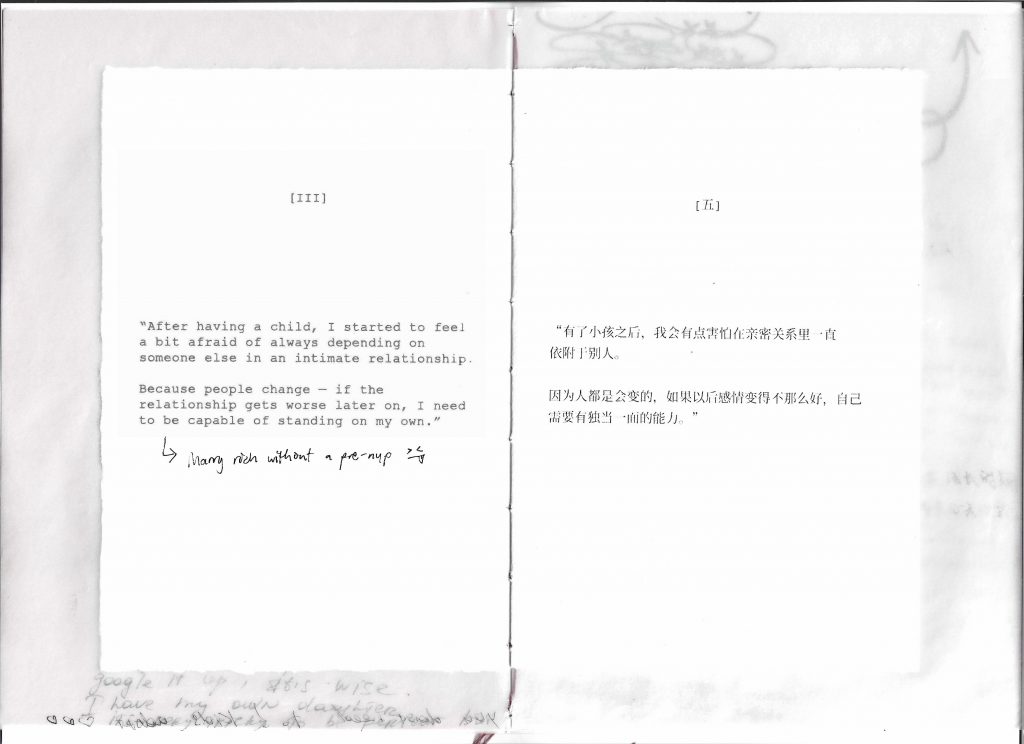
      IIIAfraid of depending on someone in an intimate relationshipEN“Marry rich without a pre-nup ;)”
      IVMum’s “cook together after work” lineENUnderline: “her definition of happiness and mine aren’t the same”
      IVENUnderline: “her experience of happiness”
      IVEN“I think she doesn’t understand happiness comes in different forms, and that my life is independent from hers…”
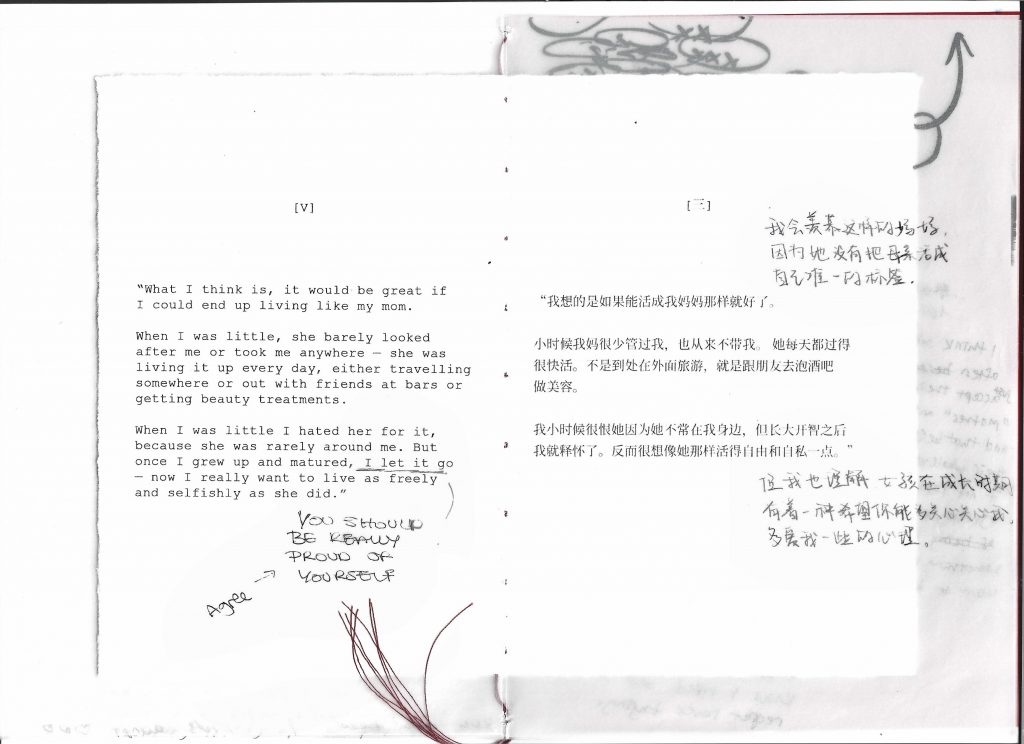
      VWanting to live as freely and selfishly as mumEN“YOU SHOULD BE REALLY PROUD OF YOURSELF”
      VEN“Agree” (under the comment above)
      三中“我会羡慕这样的妈妈,因为她没有把母亲活成自己唯一的标签。” / “I would envy a mother like this, because she didn’t make ‘mother’ her only label.”
      三中“但我也理解,女孩在成长时期有着一种希望你能多关心关心我、多爱我一些的心理。” / “But I also understand that a girl growing up wants you to care about her more and love her a little more.”
      VIMum is good but muddled; kindness yes, ordinariness noEN(none on this page; see VII)
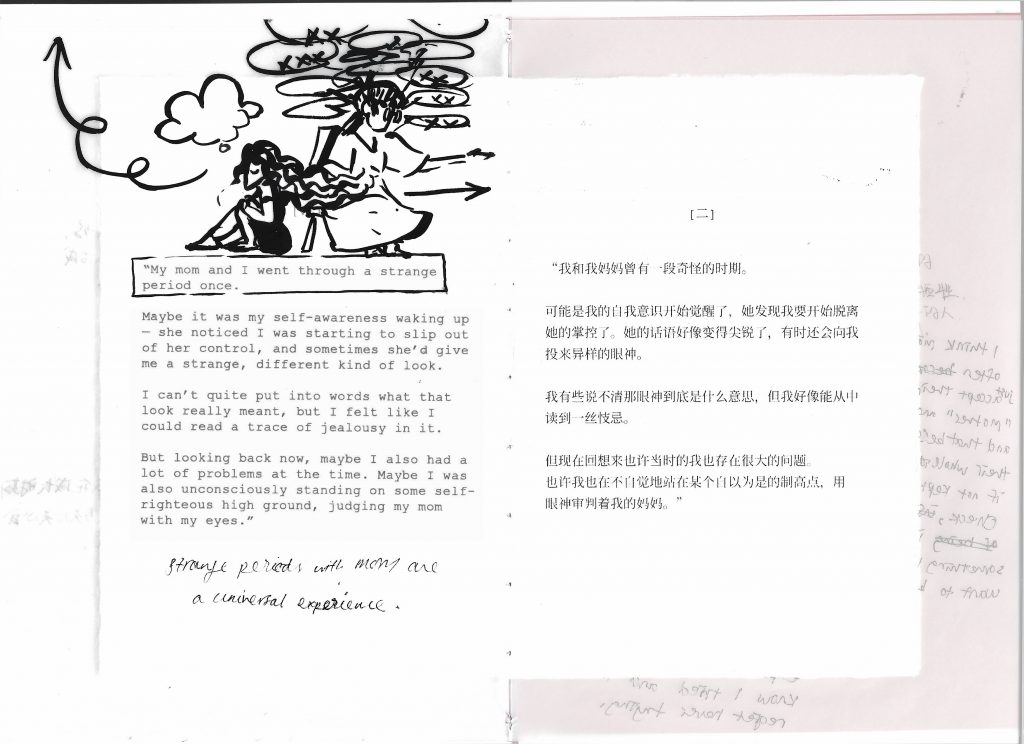
      VIIA strange period with mum; possible jealousy; “I also judged mum”EN“strange periods with mom are a universal experience.” (on VI/VII boundary)
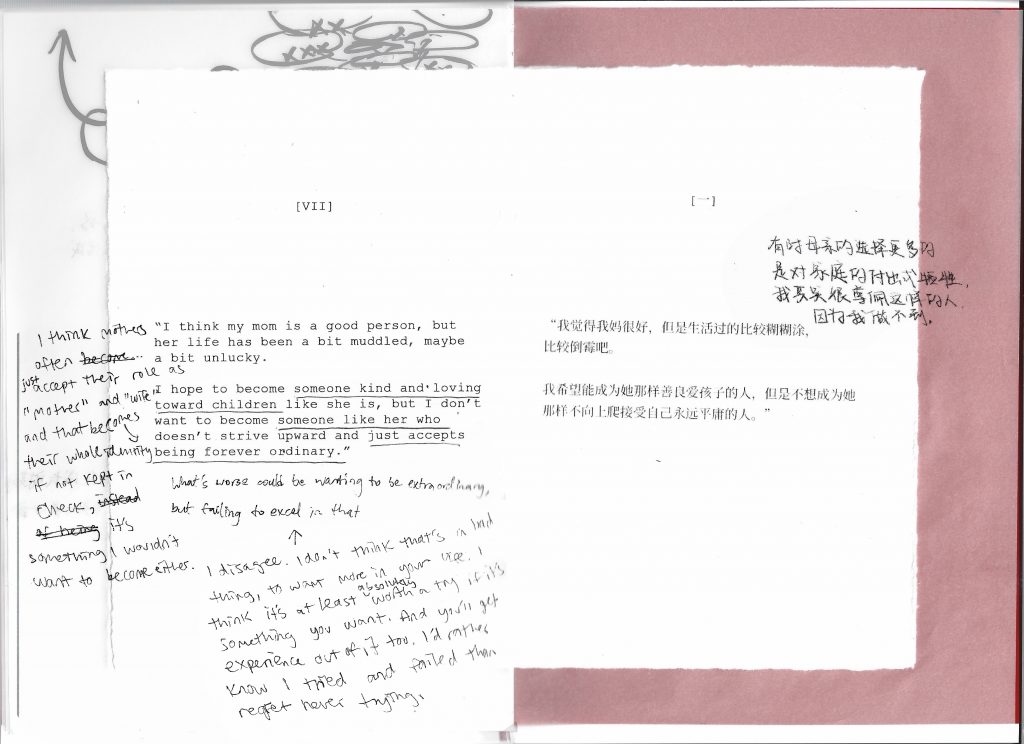
      VIIEN“I think mothers often just accept their role as ‘mothers’ and ‘wife’ and that becomes their whole identity if not kept in check, it’s something I wouldn’t want to become either”
      VIIEN“What’s worse could be wanting to be extraordinary, but failing to excel in that”
      VIIENReply to the line above: “I disagree… I’d rather know I tried and failed than regret never trying.”
      一中“有时母亲的选择更多的是对家庭的付出或牺牲,我其实很尊佩这样的人,因为我做不到。” / “Sometimes a mother’s choices are more about giving to, or sacrificing for, the family. I actually respect people like that, because I couldn’t do it.”
    3. Taking the Intervention Offline: Two Booklets

      1. Why offline

      At the last tutorial, Cecilia asked me to design a new intervention that can happen somewhere other than the internet. This is more than a change of venue. On Threads, people choose to enter a conversation. In a corridor, people are just passing by, with no prior interest in the topic.

      2. What goes into the booklets

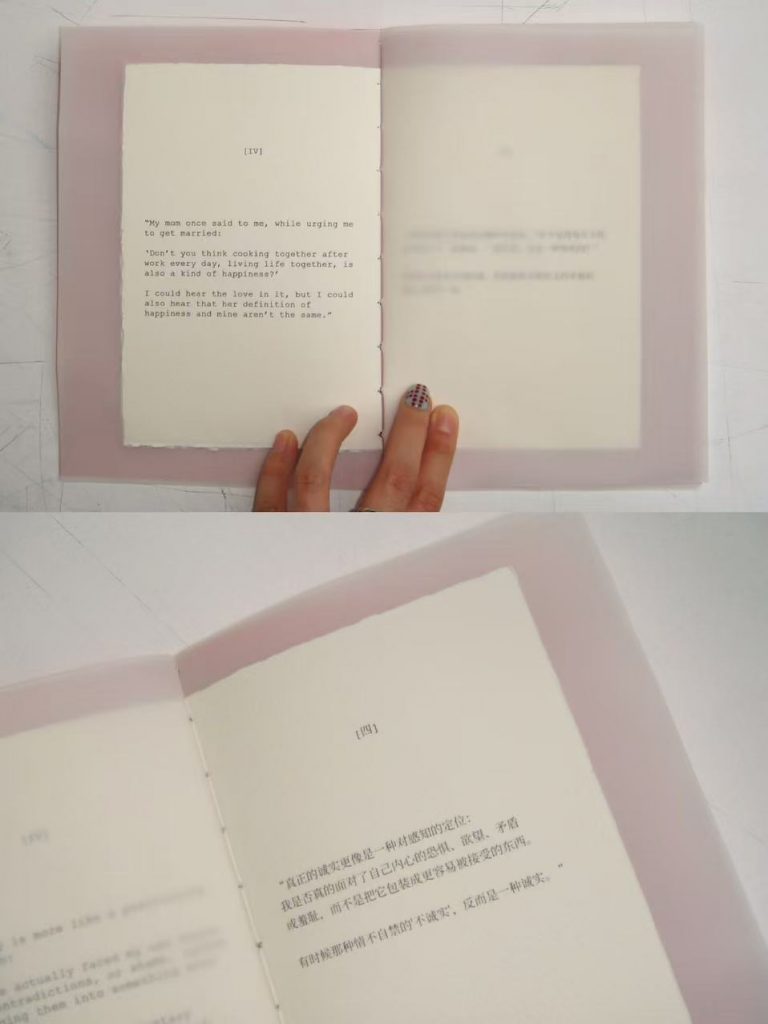
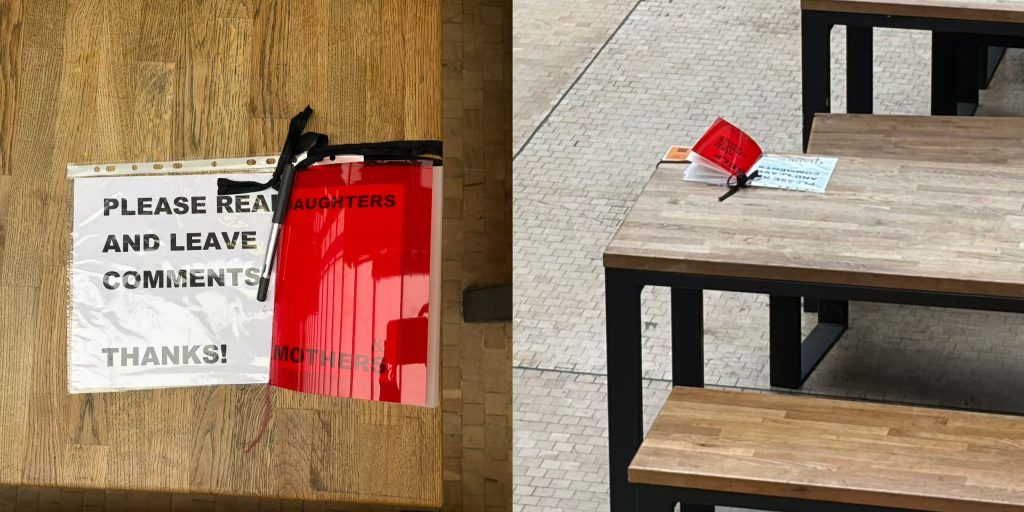
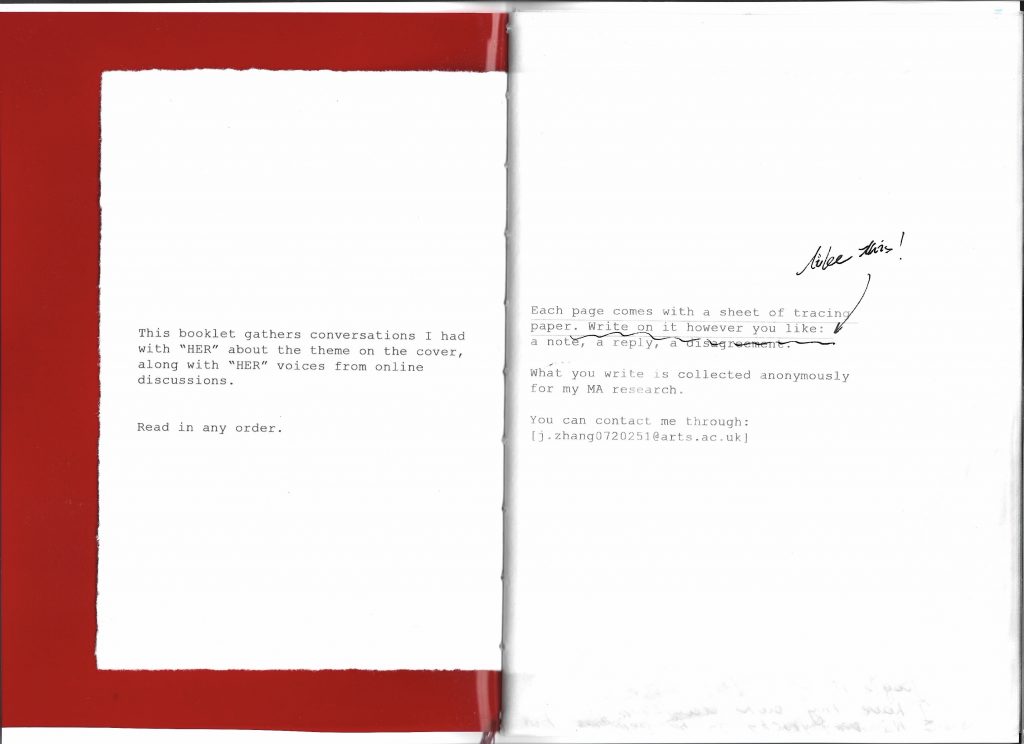
      I am turning the material I have collected (interviews and Threads posts) into small booklets, to be left in different places around the campus for a week. Readers can write directly on a sheet of tracing paper laid over each page.

      I first planned three booklets, one for each of three themes: self-love and selfishness, the daughter’s role, and who sets the rules (the qualification to be a feminist). I ended up with two. Time was one reason, but the main one was condensing: I wanted each booklet to have one clear subject that a stranger could take in within a few pages.

      The theme I left out, “who sets the rules”, is the one that needs the most analysis. It fits better in the report than in a corridor.

      The two booklets now share one logic. They are about what a woman is born with, not what she chooses: a self, the identity of being a daughter, and a mother.

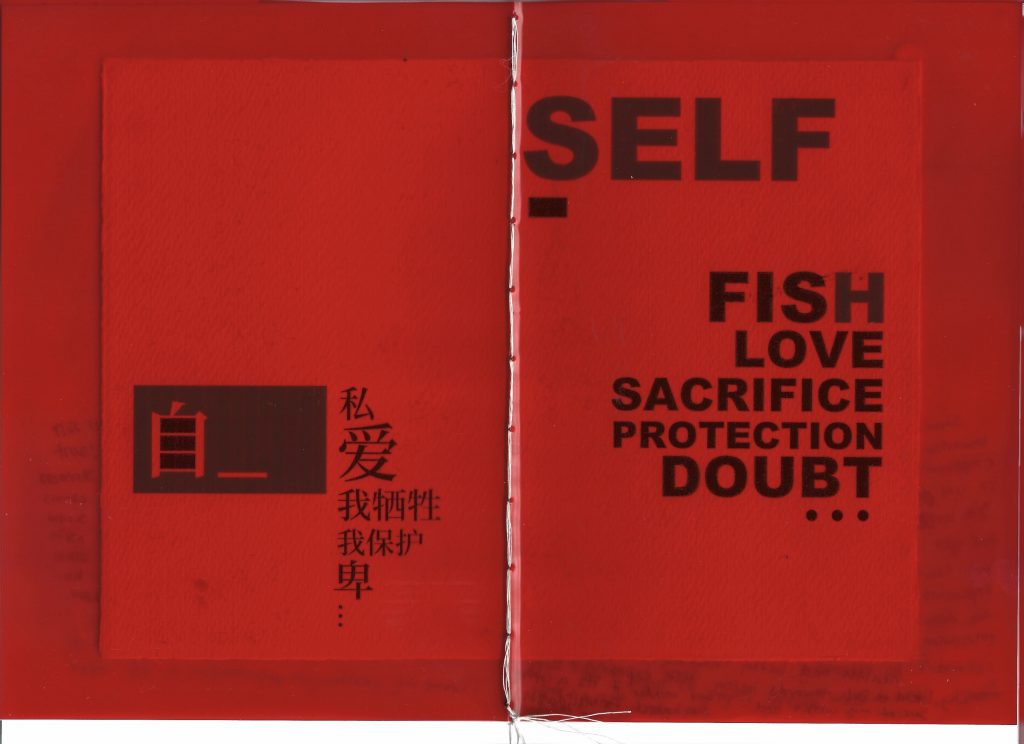
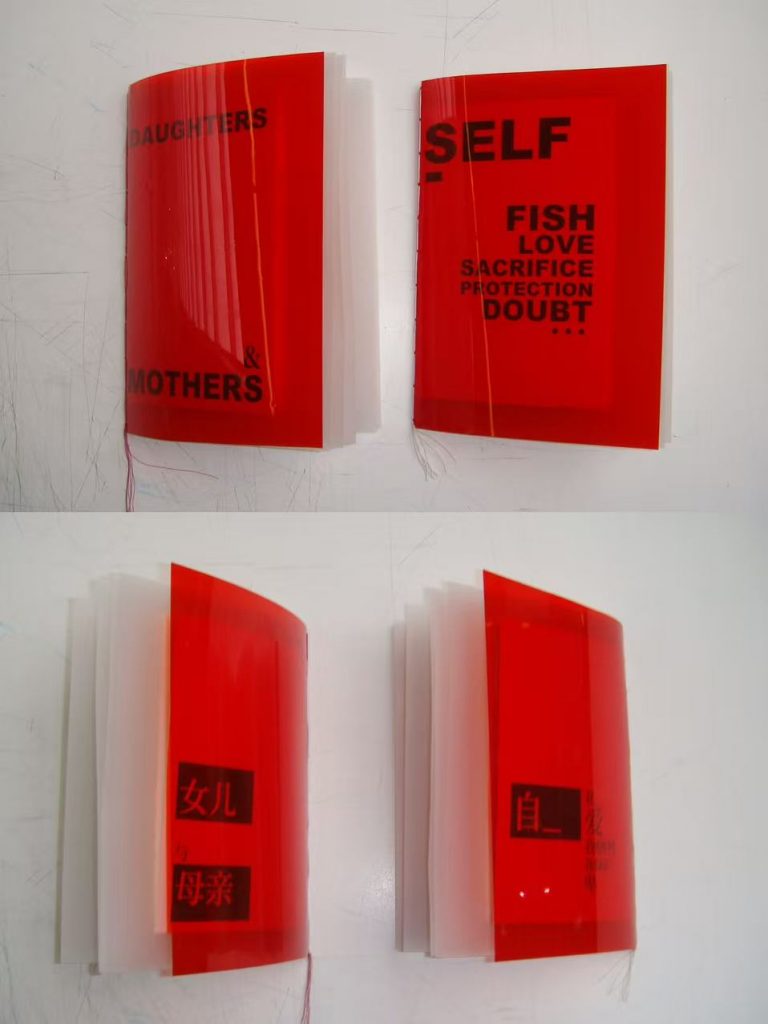
      • Booklet 1: Sel-fish, love, sacrifice, protection, doubt… How she relates to herself.
      • Booklet 2: Daughters and Mothers. The line running from daughter to mother, and what she takes from it or leaves behind.
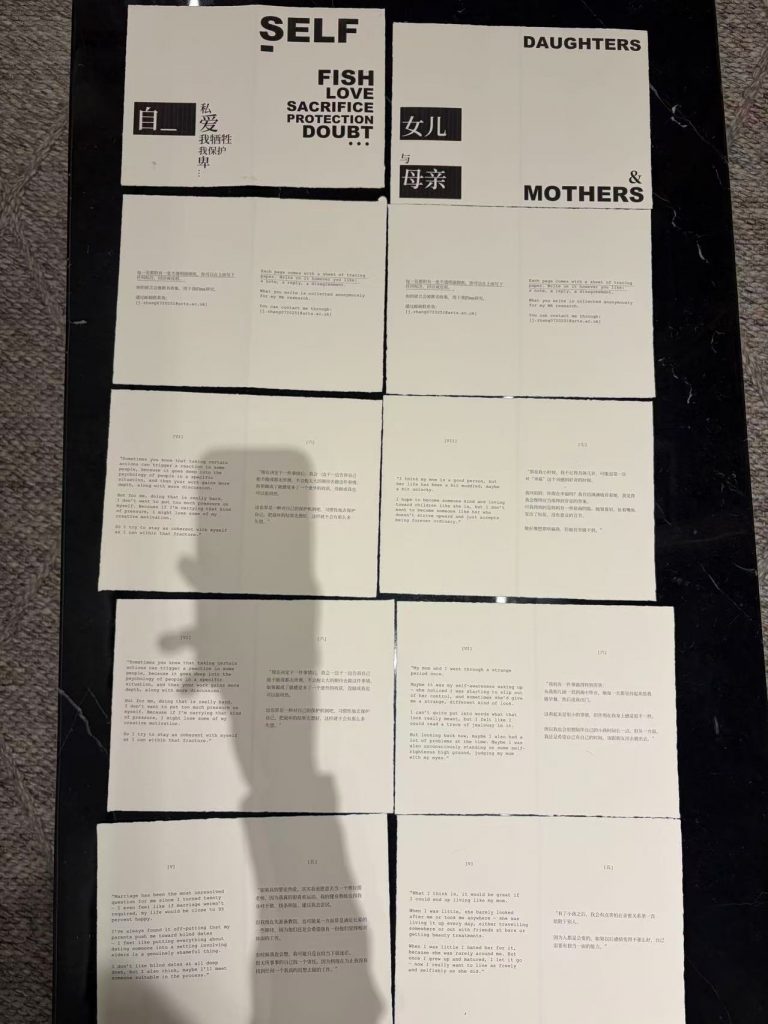
      layout of booklet pages

      3. Form: no framework

      Every page holds one quote, and the booklets contain no explanation, no argument and no questions. This comes from two places.

      • Mu’s interview and David’s feedback: I shouldn’t give the audience a framework, because Mu rejected the one I offered her.
      • My own Threads data. My third post asked a question of definition (“is being a feminist a qualification?”) and got less response. My first post, which came from personal experience (“whether East Asian daughters have all thought “I never want to live like my mother”), got the most. People respond to something they recognise, not to something they are asked to judge.

      I originally drafted a question under each quote, then removed them. A question is also a framework: it steers the reply in a direction I have already chosen.

      The tracing paper is a design decision too. A comment written on the sheet answers one specific sentence rather than the whole booklet, and I can see exactly which quote triggered it.

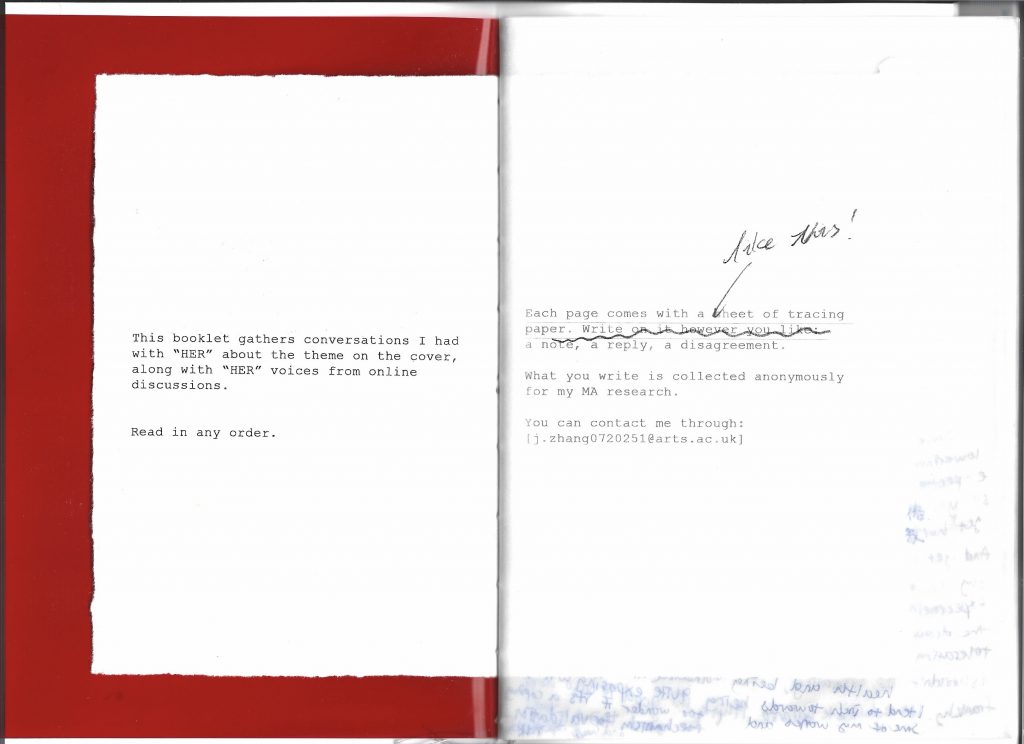
      Each booklet opens with a short statement explaining that it gathers conversations with “HER” and voices from online discussions, and invites the reader to write, or not to write.

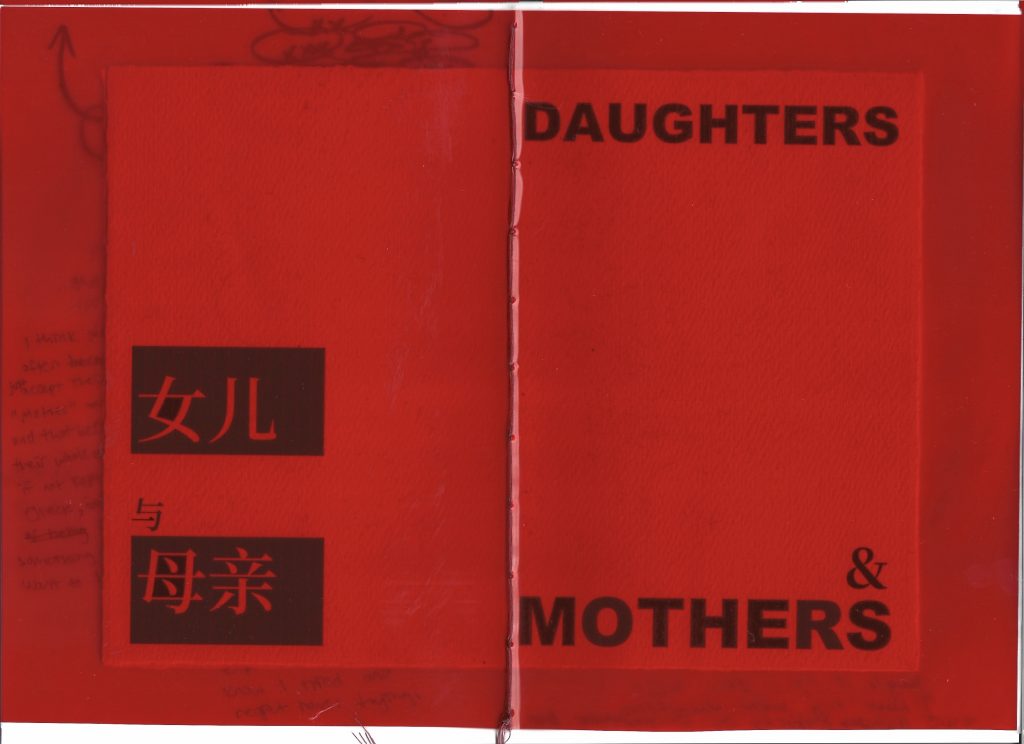
      Front and back cover of the booklets

      4. Editing and ethics

      The quotes come from my interviews, from Threads comments, and from my own writing. I edited them and, in places, merged several voices into a single first-person voice. This has a design reason: the reader is not led by “an interviewee” who has an identity, and each line stands on its own.

      Inner content

      5. What I expect, and what I don’t know

      When the booklets come back, I will analyse the comments with the same thematic analysis I used on the Threads data. What I want to see:

      • whether the two booklets get different amounts and kinds of response
      • whether people respond to the quote, or use the tracing paper to tell their own story
      • whether anyone writes something opposite to the quote
      • whether anyone sits at the stage of 疑 (sensing something is off, without a name for it), which is the group I most want to reach

      The biggest unknown is simple: will people who pass by actually write? I don’t know yet, and that is what this intervention is testing.

      where it’s being placed