Category: Interview Reflections

  • Interview Reflection #4: Fei

    “If marriage weren’t a requirement, my life would be about 95% happy.”

    Interview reflection — July 2026

    If my conversation with Hui was about a fracture so well-managed it had become invisible, my conversation with Fei was about a fracture that is fully visible and accepted. She can name what she gave up, trace how it happened, and describe the structure that shaped her choices with remarkable clarity. And yet the giving-up continues, quietly, in the background of a life that otherwise looks like everything it was supposed to be.

    Fei is a 27-year-old high school politics teacher. She has a stable job in a state institution. She has completed the two things her parents most wanted for her: a postgraduate degree and a civil service position. By most of the measures her family uses to define a good life, she has succeeded. And she is quite satisfied with her situation. But she is also honest about the bits that remain unresolved: “If marriage weren’t a requirement,” she said, “my life would be about 95% happy.”

    What struck me most about her account was not the destination but the path: the series of small redirections that led her here. She discovered her real intellectual passion in high school, when a philosophy unit in her politics class opened up what she called “a new world.” She wanted to study politics or philosophy. But when it came to university applications, she prioritised location over subject, choosing a university in Beijing meant accepting a programme she didn’t love. Then, during an exchange semester in Taiwan, something shifted: she felt the pull of national identity, decided she wanted to “cultivate talent for the motherland,” abandoned her plans to study abroad, and went back to pursue the subject she had originally wanted. Each turn had its own logic. Each one was, in some sense, a choice. And yet the cumulative effect is a life shaped less by what she wanted than by what was available, what was expected, and what felt, at each moment, like the reasonable thing to do.

    She described the teaching profession itself with a similar kind of measured realism. The initial idealism — the sense of purpose, of contributing something — has not disappeared entirely, but it has contracted. “My power is too small,” she said. “I can’t change a group of people’s lives. What I can do is give them some life experience alongside the textbook knowledge, encourage them to face life positively.” This is not bitterness. It is something quieter: the adjustment of ambition to fit the actual dimensions of a life.

    The most unguarded moment came when she talked about marriage. Her parents’ logic is affectionate and well-intentioned — they want someone to love her the way they do, they arrange blind dates to increase her chances of meeting someone suitable, they ask: “Don’t you think cooking dinner together and living together every evening is also a kind of happiness?” She can hear the love in this as she can also hear the gap between their definition of happiness and hers. What she finds hardest is not the pressure itself but the venue for it: discussing her romantic life in front of elders feels, she said, “shameful.” The private becomes legible to the family gaze, and something in that exposure feels like a violation, not of her choices, but of the territory where her choices are supposed to belong only to her.

    She has found her own form of exit. For years, alongside every official identity she has held: student, postgraduate researcher, teacher, she has maintained a parallel one: fanfiction writer. She described this practice as her “bamboo dragonfly out of reality,” a way of escaping, of releasing pressure, of inhabiting an imaginative space that her professional life cannot provide. The two identities are kept strictly separate. She does not mention her real life on her writing account. She does not let the writing bleed into her work. “One side is reality, one side is imagination,” she said, “and I don’t want my work to affect my sacred imaginary world.” The word “sacred” is not accidental. It marks the one space that has not been negotiated away.

    What Fei’s interview adds to this research is a particular kind of clarity. Unlike participants who are still in the 疑 stage, sensing something is wrong without language for it, Fei can see the mechanism clearly. She knows which choices were hers and which were structured for her. She knows the difference between her happiness and her parents’ definition of it. She has named the bits, and yet naming it has not dissolved it. The fracture persists, not because she lacks awareness, but because awareness, on its own, is not always enough to change the conditions that produced it.
  • Interview Reflection #3: Hui

    “I thought about it and realised — maybe I’m just making excuses for myself.”

    Interview reflection — July 2026

    If my conversations with Zoe and Mu were about the fracture as something named and examined through creative practice, this conversation was about the fracture as something lived — quietly, practically, and often without being noticed at all.

    Hui is 25 years old, married, with a two-year-old son. She does not make art. She speaks warmly, with humour, and with a kind of careful reasonableness that, the longer you listen, starts to feel like its own kind of management.

    The most revealing moment came not when she spoke about anything dramatic, but when she described why she is preparing for a teaching qualification. She said, almost in passing, that if she were being honest about what she actually loves, she would rather train to be a Pilates instructor. She is good at it and she enjoys it. Her fitness trainer has told her she has the right body and the right presence for it. But she is doing the teaching qualification first — because her family thinks it is more respectable. She did not describe this as a conflict. She did not pause on it. She moved straight on to the next thing. And that is precisely what made it worth stopping at: the fracture was so well-managed it had become invisible, even to her. The gap between what she wants and what she has decided is appropriate to want had already closed over, quietly, without leaving a mark.

    This pattern appeared again when she talked about expectation and disappointment. She described her approach to the qualification — and, I think, to much more than the qualification — as not wanting to hope too much, so as not to be too disappointed. I identify this as a “self-protection mechanism.” On the surface, she was talking about exam results. But the same logic was running underneath her account of her marriage. She said that having a child had made her think, for the first time, about what she would do if things fell apart — whether she could stand alone, support herself, manage without depending on anyone else. She did not say she expected her husband to fail her. She did not need to. The preparation itself said it. She is already quietly rehearsing for a disappointment she has not yet named — building the exit before she has admitted to herself that she might one day need one. This silent anticipation is its own kind of fracture: she is living in two timelines simultaneously, the one she is in and the one she is guarding against.

    There was also something I found myself returning to after the interview: her account of wanting to be with her child. She described it as something without a clear reason — just a pull, a wanting to be near him, even when other people were available to look after him. I found myself wondering where that pull comes from. Partly, it is biological — the hormonal architecture of early motherhood is real, and oxytocin does not ask for permission. But she had also told me, earlier in the conversation, that her own mother had made her breakfast and send her off to school every single day from kindergarten through high school. That memory lives in her body as warmth. She wants to give her child what she was given. So when she says she wants to be near him for no reason she can name, I am not sure the reason is absent — I think it has simply been absorbed so completely that it no longer feels like a reason. It feels like instinct. And this is perhaps the most difficult question this research keeps circling: when a woman says “I just want this,” how do we know — how does she know — whether that wanting is hers, or whether it has been handed to her so gently, over so many years, that the two have become impossible to separate?

    She also told me a story about a friend whose husband, during an argument, said: “Have you ever thought that you can buy these things because I allow it? What if one day I don’t?” She said this sentence made her feel sick. She went home and didn’t leave the house the next day. She said she rarely gets that affected by other people’s problems — but this one got through. I think it got through because it named something she already half-knew: that the permission structure inside a marriage can be invisible until suddenly it isn’t. She had spent the whole conversation describing a life she has largely made peace with. And then this story arrived, and something in her that had been carefully managed came briefly, visibly undone.

    That is the thing about the fracture. It does not always announce itself. Sometimes it arrives in someone else’s story, in a sentence spoken by a stranger’s husband, in a feeling of sickness you can’t quite explain.

  • Interview Reflection #2: Mu

    “I’m not at the ‘questioning’ stage yet — I’m still at the ‘wondering’.”

    Interview reflection — July 2026

    If my conversation with Zoe was about the weight of double consciousness, my conversation with Mu was about what it looks like when that weight hasn’t fully landed yet — and how that, too, is worth paying attention to.

    Mu describes her practice as discovering and sharing her own perspective — finding an unusual angle on things everyone is already looking at. She changes quickly, she said. Environmental concerns one moment, self-examination the next, then human connection. What stays constant is the “I” at the centre: her own viewpoint as the starting point, regardless of where the work goes.

    When I offered her the choice between “questioning” and “reconciliation” as words to describe her artistic personality, she rejected both. She’s exploring, she said. And then she did something precise: she split the Chinese word 质疑 (questioning) into its two characters — 质 (to challenge, to confront) and 疑 (to wonder, to not yet know). She sits with 疑, she said. Not 质. She hasn’t formed a strong enough position to challenge anything yet. She’s still in the wondering.

    This distinction felt important to me — not just as a description of her practice, but as a way of thinking about where my research participants might be in relation to the fracture I’m trying to surface. Some people are already at 质: they’ve seen the gap, named it, and are pushing back against it. Others are at 疑: something feels slightly off, but they haven’t found the language for it yet. My intervention, I think, needs to speak to the second group as much as the first. The moment of 疑 — that half-formed “wait, something isn’t right here” — might actually be the more delicate and more important thing to catch.

    On double consciousness, Mu’s experience was notably different from Zoe’s. She hasn’t felt the pressure strongly yet — her work is personal, not yet exhibited publicly, and she tends to steer away from topics that would invite controversy. She was honest about the ambivalence in this: she knows that work which triggers people tends to go deeper, carry more weight. But triggering others is difficult for her. So she navigates — trying to stay coherent with herself without letting that navigation become a burden that costs her the motivation to make work at all. “Some people reach outward, trying to provoke a reaction. Others reach inward, in dialogue with themselves.” She knows which one she is.

    What Mu’s interview reminded me is that the fracture between social mask and true self doesn’t always show up as conflict. Sometimes it shows up as a quiet, ongoing management — a careful self-regulation that has become so natural it barely registers as a strategy anymore. That, too, is something this research needs to account for.

  • Interview Reflection #1: Zoe

    BETWEEN
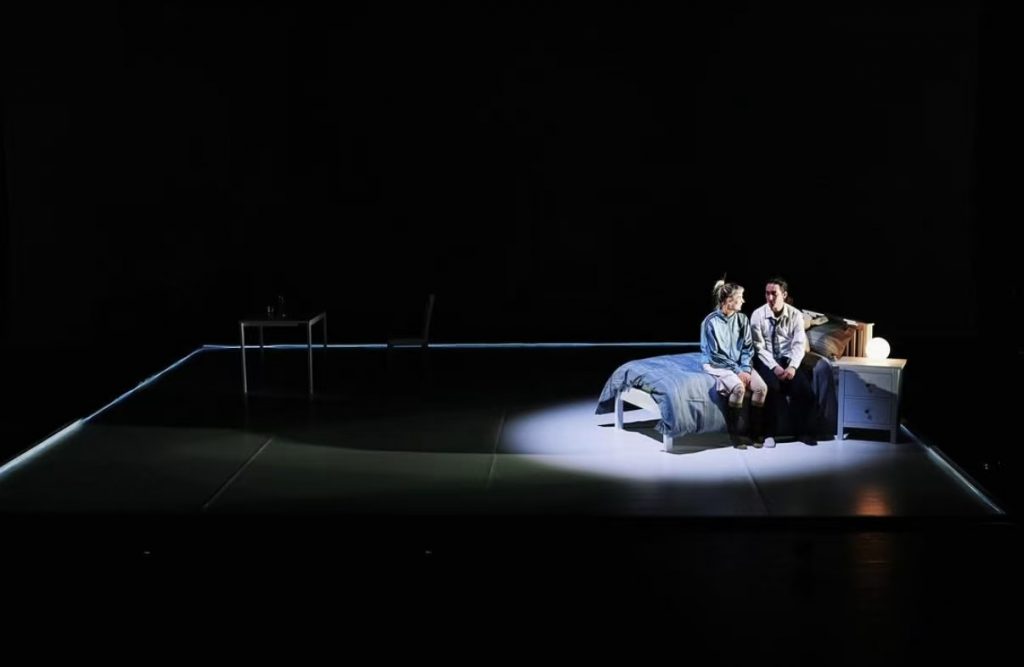
    Between>1, Directed by Zoe Zhao

    “That kind of involuntary dishonesty is, in a way, honest.”

    Interview reflection — June 2026

    One of the most important conversations I’ve had for this project so far was with Zoe, an artist working across moving image, theatre, and publishing. I went in with questions about honesty, identity, and double consciousness. What I came out with was something harder to name — and more useful for exactly that reason.

    Zoe’s practice begins not from a story or a concept, but from a bodily state. Suppressed. Exposed. Waiting. Alert. She described the body as something that remembers what the mind has already convinced itself it has forgotten — trauma, power dynamics, fear, all stored somewhere beneath conscious thought, ready to be reactivated by a particular light, a sound, a room. “Why can my brain forget something, but my body responds first?” This is the question she keeps returning to. It is also, I realised, quietly central to my own research. The social mask is not only performed — it is embodied. We don’t just say “I’m fine.” At some point, we stop feeling the gap between saying it and meaning it.

    When I asked about honesty in art, her answer reframed the question entirely. Honesty in creative practice, she said, is not the same as self-exposure. It is about whether you have truly faced your own fears, contradictions, desires, and shame — rather than packaging them into something more palatable. The “dishonesty” she identifies in art is not lying. It is over-explaining. And then she said something I keep thinking about: “Sometimes that involuntary dishonesty is, in a way, honest.” The transformation that happens between a raw feeling and its artistic form will always involve some distortion — just as language loses something in translation. That loss is not a failure. It might be where the work actually lives.

    On the question of double consciousness, she was direct. As a Chinese woman artist working in London, she is aware of two sets of projections running simultaneously — what Chinese cultural context expects of her, and what the Western art world imagines a Chinese female artist should be. She refuses both. “I don’t need to create for the image of the ‘Eastern artist’ that people expect.” What struck me was not the refusal itself, but how clearly she could see the mechanism — and how deliberately she had decided not to let it dictate the work.

    Her family, she mentioned, knows she makes art but doesn’t really understand what she makes. “They’ve run out of options and just have to accept it.” There was no bitterness in how she said it — just a quiet acknowledgement that the people closest to us in life are sometimes the furthest from our creative selves. I’ve been thinking about that ever since.