Category: Secondary Researches

  • Thematic Analysis of the Netnography data

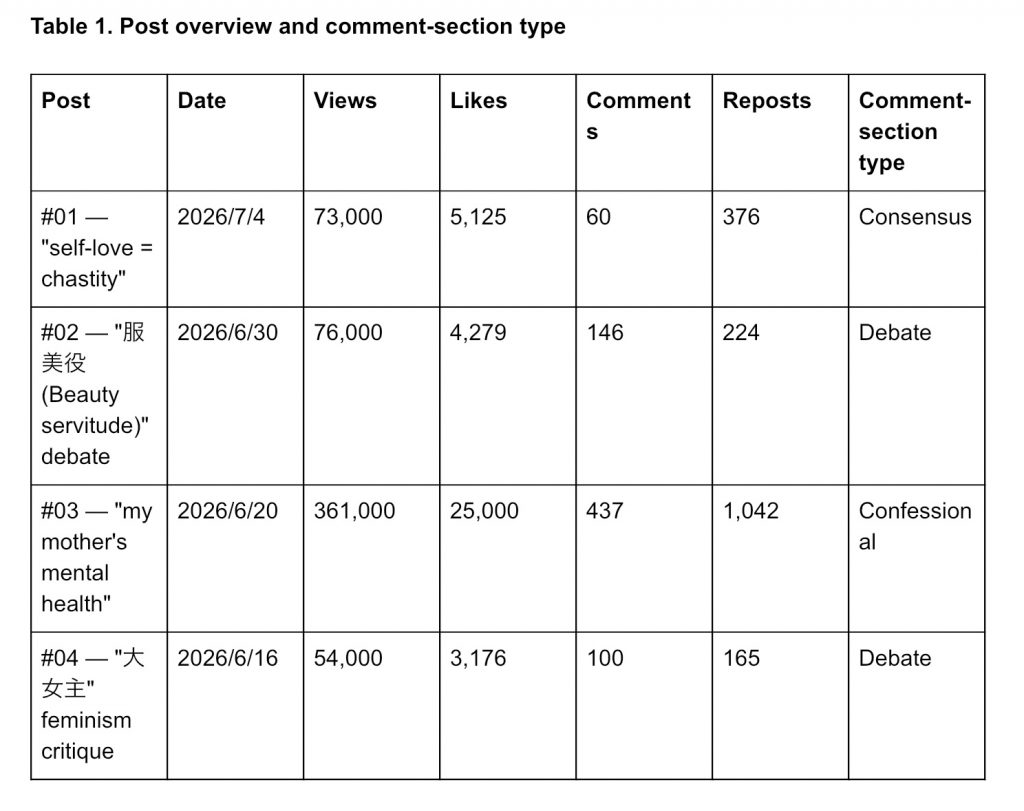
    I have collected four threads that address my research question from a range of angles, and a pattern is already harder to ignore than I expected.

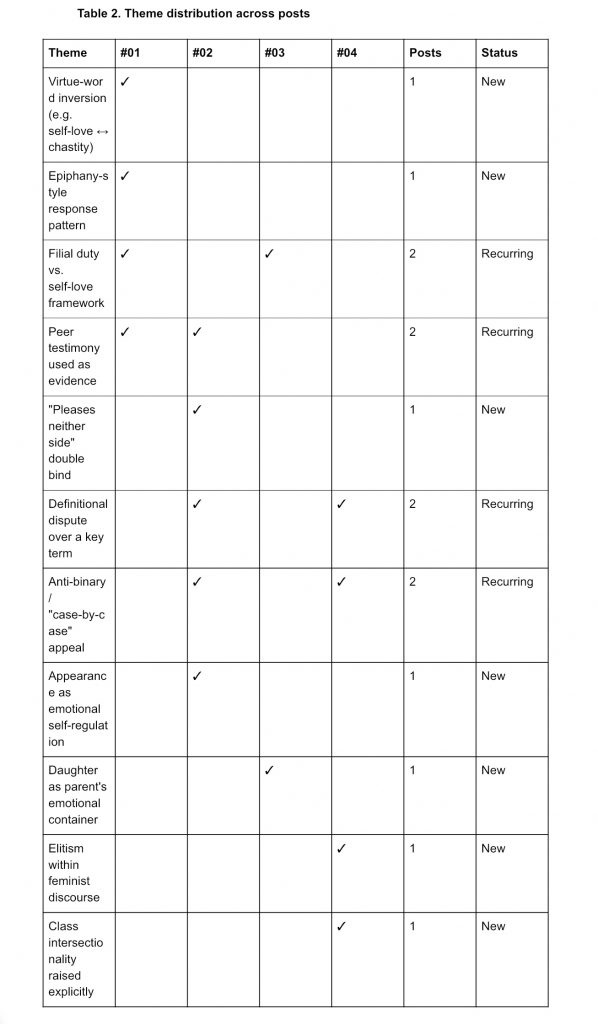
    My method has been simple: collect a post and its comment section, pull out the words and phrases that keep recurring, group them into themes, then ask what each theme is doing — not just what it says, but what cultural expectation it’s quietly enforcing or exposing. What I didn’t plan for was how consistently the source of that expectation would keep moving.
    Post #01: Self-love, selfish or chastity

    The core argument of Post #01 is:

    What Chinese culture calls “self-love” is really chastity, and what it calls “selfish” is the real self-love.

    The comment section splits into two registers — short bursts of epiphany (“I get it now,” “mind blown”) and longer testimonies people volunteer about their own parents or teachers policing them with the same word. Reading Mu’s interview again while coding this, her distinction between 质 (challenging something you’ve named) and 疑 (sensing something’s off before you can name it) mapped almost too neatly onto these two comment types. The short exclamations look like 疑 snapping into 质 in real time, in public.

    Post #02: Serving or resisting patriarchy?

    Post #02 complicates that immediately. It’s a debate, not a consensus, about:

    whether things like long nails or heavy makeup count as resisting patriarchy or serving it.

    In the online culture of China, there’s a popular phrase: “服美役(Beauty servitude)”, refers to the tiring, costly labour — mainly for women — of keeping up with society’s beauty ideals. It frames endless appearance work like a form of duty or labour, driven by social and gendered expectations, not just personal pleasure.

    The author argues that many appearance‑related choices can also act as expressions of “anti‑patriarchal” resistance, and should not be simplistically labelled as “beauty servitude”.

    The poster ends up admitting she’s “两边不讨好” (pleasing neither side). That phrase has stayed with me. It’s not patriarchy versus resistance anymore; it’s two competing judgement systems, each claiming the moral high ground, and a woman caught between them regardless of what she does with her own nails.

    Post #03: Role of being a daughter

    Post #03 moves the expectation back into the family, but not in the way the original post intended. It opens asking why nobody cares about middle-aged women’s mental health, and the comments — mostly from daughters — turn it into something else: dozens of women describing themselves as:

    “我妈的女儿,我妈的丈夫,我妈的母亲”

    (my mother’s daughter, her husband, her mother)

    cycling through whatever emotional role she needs filled. It was never named as an expectation; it just kept getting handed to them.

    Post #04: Qualifications of being a feminist

    Post #04 was the one that actually shifted how I’m thinking about many things. The poster critiqued the “大女主 (dominant female protagonist)” narrative that has become popular in the country in recent years.

    whether only “大女主” (economically independent, self-made, uncompromising women) count as real feminists,

    while married women, working-class women, or anyone simply not exceptional get quietly disqualified.

    This follows the same logical trick shown in Post #01, where self-love was falsely equated with chastity. This time, the rule is no longer set by traditional patriarchy, but by a new narrative that claims to bring liberation.

    For my research, this means cultural expectations cannot be simply divided into “patriarchy versus anti-patriarchy”. Unspoken social rules can come from any group that believes it is morally correct — including feminist discourse itself.

  • Coming Back to the Research Onion

    Unit3’s research has reached its midpoint, and I already have quite a lot of data and thinking. As David suggested, I now need to sort out the philosophical structure of this project, so that I can move forward more constructively.

    1. Philosophical position: What I am looking for is not a fact, but an experience and a way of thinking

    What I have always wanted to explore is not a solid, concrete problem, but a feeling and a phenomenon. Then to see whether other young Chinese women also recognize this feeling. This already shows that I stand on the side of interpretivism, not positivism. Cultural expectation is not something with one single “truth” that can be measured, it is something constructed by people, performed and interpreted.

    2. Research path: Theory should not be my fixed route

    My theoretical support is Du Bois’s double consciousness, but I cannot use it to predict what my participants will say. I think its use might be to help me notice things I would otherwise overlook, and then let the interviews and data confirm it (or even disprove it) in return. After all, this is research under a Western framework, so I should use the observations I get within the context of Chinese culture to reach my own conclusions, rather than just confirming an existing theory. So this is not deductive. It is closer to abductive: theory and data are shaping each other, and the reason I keep changing my research question along the way is exactly because I keep discovering new problems and factors.

    3. Methodology choice: Multiple methods

    Autoethnography, netnography, semi-structured interviews. Using three different dimensions (my own, the online one, and other women’s) to explore one question. I think none of these alone would be honest or effective enough to respond to this issue. I need several angles to be able to see and describe it clearly.

    4. Research strategy: Ethnography

    The posts on Threads are themselves part of the fieldwork; the responses they trigger, in turn, feed back into my understanding of the research question. This makes it essentially ethnographic, but with elements of action research: I put something into the environment, see what it triggers, and then adjust.

    5. Time dimension: Cross-sectional

    Because the project has a deadline, this project must necessarily be cross-sectional. It is a slice, not a longitudinal study tracking how this crack changes over many years. I think the cross-sectional setup is exactly what makes the intervention more concrete. Having a limited range actually lets the research be more focused: a set time window and frame can help the researcher not drift off direction.

    6. Technical method: Thematic analysis

    After collecting the Threads posts, what needs to be done is to carefully analysis the Threads data: which words keep appearing repeatedly, what kind of discussion they form, and what these discussions mean in relation to the research question, rather than just picking out the one comment that personally moved me the most.

  • Research on Netnography

    Netnography was developed by researcher Robert Kozinets in the 1990s as an adaptation of traditional ethnography for online environments. Where ethnography studies communities and cultures through immersive observation, netnography applies that same logic to digital spaces — blogs, forums, social networks, and content platforms — examining the lived experiences of individuals as they naturally unfold online.  It is defined as a qualitative research approach for gaining cultural understanding through systematic, immersive, and multimodal use of observations, digital traces, and direct engagement — emphasising researcher involvement, ethical consideration, and contextualisation.

    • The six steps (Kozinets)

    Kozinets outlines six steps for netnographic research: research planning, entrée, data collection, interpretation, ensuring ethical standards, and research representation.  Crucially, ethical consideration is not a final step — it runs through the entire process from the beginning.

    • Key ethical considerations for this project

    In public forums where anyone is free to join and post, researchers are not required to seek individual informed consent — the material is already publicly available. However, in private groups, researchers must seek approved access and make their role as a researcher known.

    Since I am working primarily with public-facing platforms (Threads, Weibo, Instagram, Rednote), I fall into the first category. But this does not mean ethics can be set aside. Several principles still apply directly to my work:

    – **Anonymisation**: even if a post is public, the person behind it did not consent to being studied. Names, handles, and any identifying details must be removed before material is used in research or publication.

    – **Context sensitivity**: posts about emotional experience, identity, and pain are particularly sensitive. The fact that someone shared something publicly does not mean they intended it to be analysed and reproduced in an academic context.

    – **Researcher positionality**: as someone who shares the cultural background of many of the people I am observing, I bring both proximity and bias. This needs to be acknowledged and reflected on throughout.

    – **Parasocial risk**: if this research gains any visibility — through a public account, a zine, or other outputs — it may attract people who are themselves experiencing distress. Guidelines directing people toward appropriate professional support will need to be built into whatever I publish.

    Bibliography

    Kozinets, R.V. (2010) Netnography: Doing Ethnographic Research Online. London: Sage.