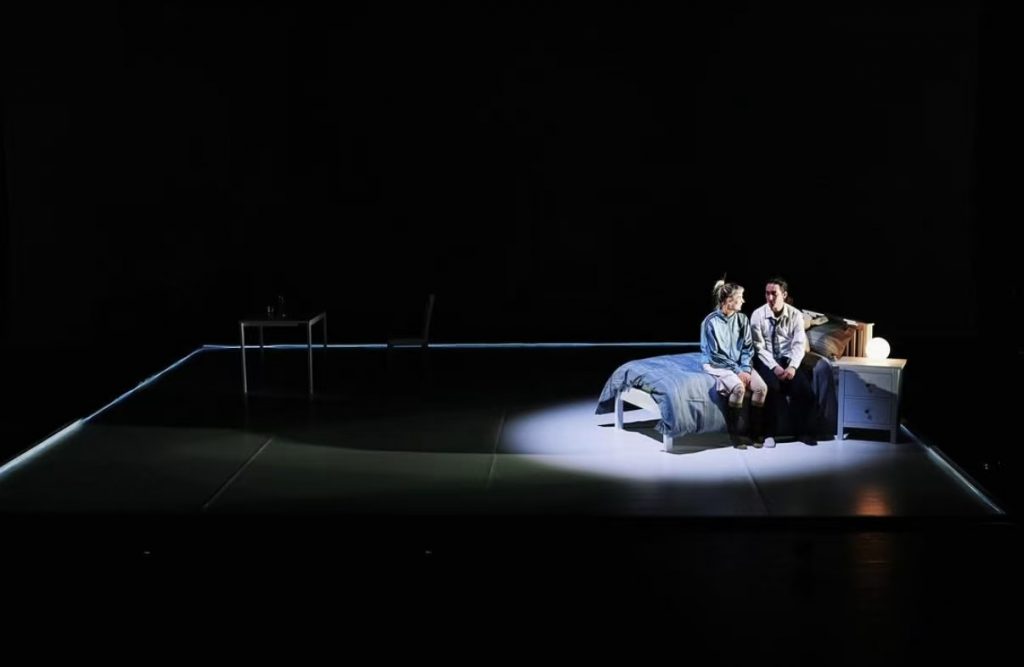
Between>1, Directed by Zoe Zhao
“That kind of involuntary dishonesty is, in a way, honest.”
Interview reflection — June 2026
One of the most important conversations I’ve had for this project so far was with Zoe, an artist working across moving image, theatre, and publishing. I went in with questions about honesty, identity, and double consciousness. What I came out with was something harder to name — and more useful for exactly that reason.
Zoe’s practice begins not from a story or a concept, but from a bodily state. Suppressed. Exposed. Waiting. Alert. She described the body as something that remembers what the mind has already convinced itself it has forgotten — trauma, power dynamics, fear, all stored somewhere beneath conscious thought, ready to be reactivated by a particular light, a sound, a room. “Why can my brain forget something, but my body responds first?” This is the question she keeps returning to. It is also, I realised, quietly central to my own research. The social mask is not only performed — it is embodied. We don’t just say “I’m fine.” At some point, we stop feeling the gap between saying it and meaning it.
When I asked about honesty in art, her answer reframed the question entirely. Honesty in creative practice, she said, is not the same as self-exposure. It is about whether you have truly faced your own fears, contradictions, desires, and shame — rather than packaging them into something more palatable. The “dishonesty” she identifies in art is not lying. It is over-explaining. And then she said something I keep thinking about: “Sometimes that involuntary dishonesty is, in a way, honest.” The transformation that happens between a raw feeling and its artistic form will always involve some distortion — just as language loses something in translation. That loss is not a failure. It might be where the work actually lives.
On the question of double consciousness, she was direct. As a Chinese woman artist working in London, she is aware of two sets of projections running simultaneously — what Chinese cultural context expects of her, and what the Western art world imagines a Chinese female artist should be. She refuses both. “I don’t need to create for the image of the ‘Eastern artist’ that people expect.” What struck me was not the refusal itself, but how clearly she could see the mechanism — and how deliberately she had decided not to let it dictate the work.
Her family, she mentioned, knows she makes art but doesn’t really understand what she makes. “They’ve run out of options and just have to accept it.” There was no bitterness in how she said it — just a quiet acknowledgement that the people closest to us in life are sometimes the furthest from our creative selves. I’ve been thinking about that ever since.
Leave a Reply