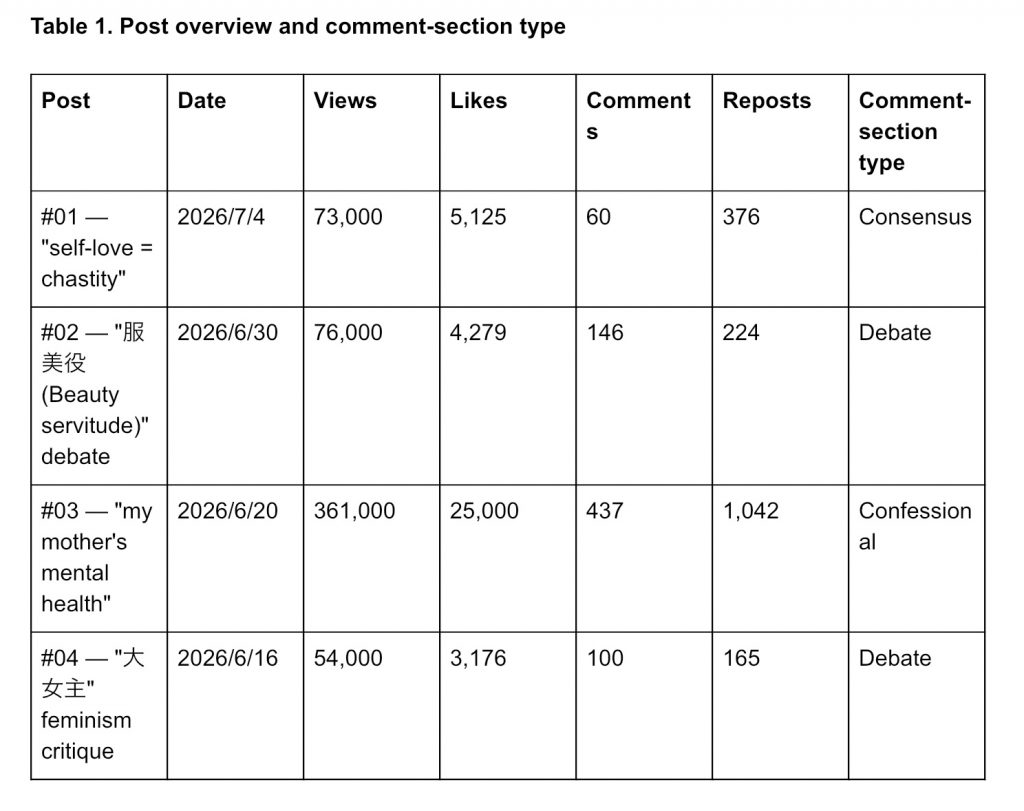
I have collected four threads that address my research question from a range of angles, and a pattern is already harder to ignore than I expected.
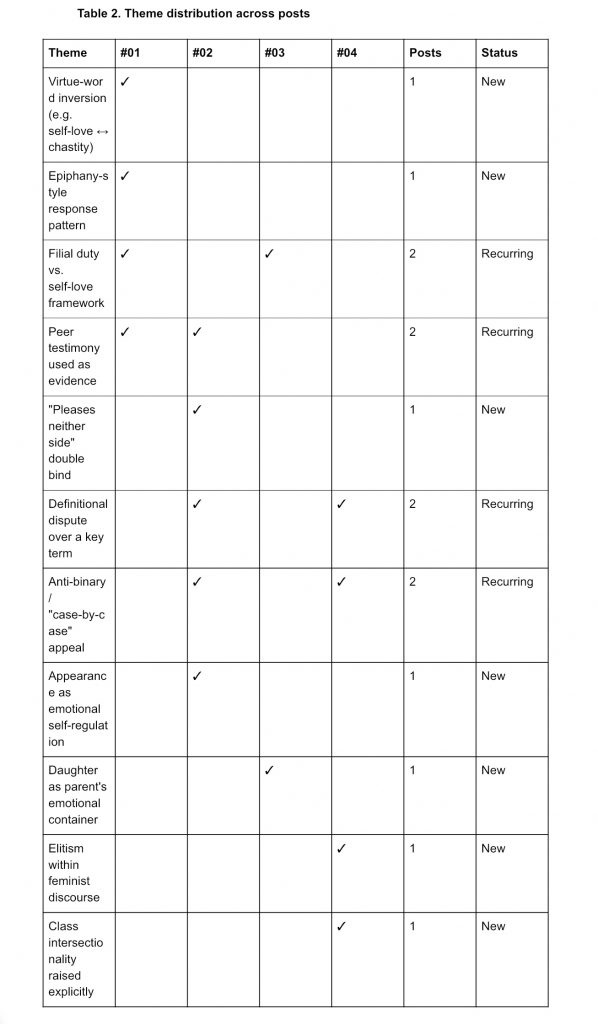
My method has been simple: collect a post and its comment section, pull out the words and phrases that keep recurring, group them into themes, then ask what each theme is doing — not just what it says, but what cultural expectation it’s quietly enforcing or exposing. What I didn’t plan for was how consistently the source of that expectation would keep moving.
Post #01: Self-love, selfish or chastity
The core argument of Post #01 is:
What Chinese culture calls “self-love” is really chastity, and what it calls “selfish” is the real self-love.
The comment section splits into two registers — short bursts of epiphany (“I get it now,” “mind blown”) and longer testimonies people volunteer about their own parents or teachers policing them with the same word. Reading Mu’s interview again while coding this, her distinction between 质 (challenging something you’ve named) and 疑 (sensing something’s off before you can name it) mapped almost too neatly onto these two comment types. The short exclamations look like 疑 snapping into 质 in real time, in public.
Post #02: Serving or resisting patriarchy?
Post #02 complicates that immediately. It’s a debate, not a consensus, about:
whether things like long nails or heavy makeup count as resisting patriarchy or serving it.
In the online culture of China, there’s a popular phrase: “服美役(Beauty servitude)”, refers to the tiring, costly labour — mainly for women — of keeping up with society’s beauty ideals. It frames endless appearance work like a form of duty or labour, driven by social and gendered expectations, not just personal pleasure.
The author argues that many appearance‑related choices can also act as expressions of “anti‑patriarchal” resistance, and should not be simplistically labelled as “beauty servitude”.
The poster ends up admitting she’s “两边不讨好” (pleasing neither side). That phrase has stayed with me. It’s not patriarchy versus resistance anymore; it’s two competing judgement systems, each claiming the moral high ground, and a woman caught between them regardless of what she does with her own nails.
Post #03: Role of being a daughter
Post #03 moves the expectation back into the family, but not in the way the original post intended. It opens asking why nobody cares about middle-aged women’s mental health, and the comments — mostly from daughters — turn it into something else: dozens of women describing themselves as:
“我妈的女儿,我妈的丈夫,我妈的母亲”
(my mother’s daughter, her husband, her mother)
cycling through whatever emotional role she needs filled. It was never named as an expectation; it just kept getting handed to them.
Post #04: Qualifications of being a feminist
Post #04 was the one that actually shifted how I’m thinking about many things. The poster critiqued the “大女主 (dominant female protagonist)” narrative that has become popular in the country in recent years.
whether only “大女主” (economically independent, self-made, uncompromising women) count as real feminists,
while married women, working-class women, or anyone simply not exceptional get quietly disqualified.
This follows the same logical trick shown in Post #01, where self-love was falsely equated with chastity. This time, the rule is no longer set by traditional patriarchy, but by a new narrative that claims to bring liberation.
For my research, this means cultural expectations cannot be simply divided into “patriarchy versus anti-patriarchy”. Unspoken social rules can come from any group that believes it is morally correct — including feminist discourse itself.
Leave a Reply