Blog

  • Interview Reflection #4: Fei

    “If marriage weren’t a requirement, my life would be about 95% happy.”

    Interview reflection — July 2026

    If my conversation with Hui was about a fracture so well-managed it had become invisible, my conversation with Fei was about a fracture that is fully visible and accepted. She can name what she gave up, trace how it happened, and describe the structure that shaped her choices with remarkable clarity. And yet the giving-up continues, quietly, in the background of a life that otherwise looks like everything it was supposed to be.

    Fei is a 27-year-old high school politics teacher. She has a stable job in a state institution. She has completed the two things her parents most wanted for her: a postgraduate degree and a civil service position. By most of the measures her family uses to define a good life, she has succeeded. And she is quite satisfied with her situation. But she is also honest about the bits that remain unresolved: “If marriage weren’t a requirement,” she said, “my life would be about 95% happy.”

    What struck me most about her account was not the destination but the path: the series of small redirections that led her here. She discovered her real intellectual passion in high school, when a philosophy unit in her politics class opened up what she called “a new world.” She wanted to study politics or philosophy. But when it came to university applications, she prioritised location over subject, choosing a university in Beijing meant accepting a programme she didn’t love. Then, during an exchange semester in Taiwan, something shifted: she felt the pull of national identity, decided she wanted to “cultivate talent for the motherland,” abandoned her plans to study abroad, and went back to pursue the subject she had originally wanted. Each turn had its own logic. Each one was, in some sense, a choice. And yet the cumulative effect is a life shaped less by what she wanted than by what was available, what was expected, and what felt, at each moment, like the reasonable thing to do.

    She described the teaching profession itself with a similar kind of measured realism. The initial idealism — the sense of purpose, of contributing something — has not disappeared entirely, but it has contracted. “My power is too small,” she said. “I can’t change a group of people’s lives. What I can do is give them some life experience alongside the textbook knowledge, encourage them to face life positively.” This is not bitterness. It is something quieter: the adjustment of ambition to fit the actual dimensions of a life.

    The most unguarded moment came when she talked about marriage. Her parents’ logic is affectionate and well-intentioned — they want someone to love her the way they do, they arrange blind dates to increase her chances of meeting someone suitable, they ask: “Don’t you think cooking dinner together and living together every evening is also a kind of happiness?” She can hear the love in this as she can also hear the gap between their definition of happiness and hers. What she finds hardest is not the pressure itself but the venue for it: discussing her romantic life in front of elders feels, she said, “shameful.” The private becomes legible to the family gaze, and something in that exposure feels like a violation, not of her choices, but of the territory where her choices are supposed to belong only to her.

    She has found her own form of exit. For years, alongside every official identity she has held: student, postgraduate researcher, teacher, she has maintained a parallel one: fanfiction writer. She described this practice as her “bamboo dragonfly out of reality,” a way of escaping, of releasing pressure, of inhabiting an imaginative space that her professional life cannot provide. The two identities are kept strictly separate. She does not mention her real life on her writing account. She does not let the writing bleed into her work. “One side is reality, one side is imagination,” she said, “and I don’t want my work to affect my sacred imaginary world.” The word “sacred” is not accidental. It marks the one space that has not been negotiated away.

    What Fei’s interview adds to this research is a particular kind of clarity. Unlike participants who are still in the 疑 stage, sensing something is wrong without language for it, Fei can see the mechanism clearly. She knows which choices were hers and which were structured for her. She knows the difference between her happiness and her parents’ definition of it. She has named the bits, and yet naming it has not dissolved it. The fracture persists, not because she lacks awareness, but because awareness, on its own, is not always enough to change the conditions that produced it.

  • Hotroom project wk2

    Last week I shared my interventions and what they revealed. This post covers what I plan to do with that between now and December.

    What the three posts showed me

    Looking back at the interventions, I found that posts about personal scenes drew far more replies than the abstract one. Awareness surfaced fastest around family, and more slowly around media. My own replies mostly agreed rather than asked questions, which likely closed conversations down instead of opening them.

    Three gaps in my data

    Fathers and other relatives. My audience named them, but I never asked about them directly.

    Self-selection. The people who reply are self-selecting. People who already have some feminist awareness reply, and people who don’t, don’t.

    Feminist gatekeeping. On this theme, I expected people to debate whether being a feminist is a privilege. Instead, some replies stepped outside that framing entirely, arguing that feminism shouldn’t involve qualification at all. I only have five comments, so I can’t yet tell whether this reframing is common or specific to this small sample.

    Mothers/family and media are my strongest areas of data. Feminist gatekeeping is thin, and fathers/relatives is empty.

    What I’m adding

    First, a post specifically about fathers and extended family, to test whether it gets the same response as the mother post.

    Second, I’m reaching out to a psychologist or mental health expert on attachment theory, with a specific question. When a daughter is forced into the role of her mother’s emotional support, what does that do to her attachment patterns later, in her own intimate relationships? This links directly to a theme from my netnography: the daughter as her parent’s emotional container.

    My biases and assumptions

    I hold four going in.

    1. My interview sample includes both artists (Mu and Zoe) and non-artists (Hui and Fei). But all four are willing to sit down and talk about this at length, which is itself a form of selection.
    2. I am inside the group I study. This helps with access, but it shapes what I notice.
    3. My theoretical frame, Du Bois’s double consciousness, comes from a US context of race, and I am applying it to gender in a Chinese context.
    4. Threads’ algorithm surfaces people willing to discuss this publicly, so quieter disagreement may be invisible to me.

    Reading

    To fill the gap I found this week, I’m adding attachment theory, to work with the theme of the daughter as her parent’s emotional container. I’m continuing with Kozinets on netnography and Braun and Clarke on thematic analysis, alongside Du Bois, Behar, hooks and Lorde. I’m also looking for Chinese-language sources. If they turn out to be scarce, I will treat that scarcity as a finding.

    Timeline

    • This week: the father and relatives post, and outreach to the attachment-theory expert.
    • Through October: the expert consultation, folded into my literature review, together with the reframing question about feminist gatekeeping.
    • By 9 November: a draft of my Evaluative Report, for that week’s tutorial.
    • By 16 November: a rehearsed presentation draft, for the following tutorial.
    • By 23 November: the final Report submitted.
    • 30 November or 1 December: presentation.
  • Interview Transcript#4: Fei

    Why did you choose to become a teacher? When did this idea first come to you?

    F: The first reason I chose to be a teacher is that my mum, my aunt, and my uncle are all teachers — everyone always felt that being a teacher meant good holidays and a decent salary, and elders generally encourage children to go into a field they’re already familiar with. Like around me, kids of parents who work at the tobacco bureau end up at the tobacco bureau, kids of parents in education become teachers — for elders, if the child can go into the state system (体制内), that’s the first choice. This is extremely common.

    Why politics specifically? Is there a specific experience or reason behind this choice?

    F: The second reason is that I’ve loved politics since high school. Back then, high school politics had four textbooks — Economic Life, Social Life, Philosophical Life, and Cultural Life. When we got to philosophy, it felt like a door to a new world opened for me — for the first time I started thinking about life through a scientific worldview, and I felt like Marxist theory could resolve a lot of the troubles in my life. I could memorize the material really fast, and I did well in that subject. That’s when the idea of wanting to keep studying politics or philosophy in the future first started forming. At the time I applied for the early admissions track at Hunan Normal University (which is also where I later did my postgraduate degree) — they only take three students nationwide, and I placed third, but I was three points short on the gaokao, so I couldn’t do my undergraduate degree there. On top of that, I only wanted to go to university in Beijing at the time, so to get into a school in Beijing, I loosened my requirements on the subject. That’s just how the gaokao system works in China — schools in Beijing and Shanghai have the highest score cutoffs, so the same score that might get you into a good school in a more remote region gets discounted once you’re aiming for Beijing or Shanghai. So at the time, to stay in Beijing, I chose a humanities/social sciences major I wasn’t that keen on — it was tangentially related to Marxist theory, but the more I studied it, the less I liked it. From my second year, I started preparing for IELTS to go study management in the UK, but in the first semester of my third year, I did an exchange in Taiwan. Being there, influenced by teachers and classmates, I discovered that a lot of my Taiwanese peers supported Taiwanese independence, and they still used the Republic of China calendar system even now. In the eyes of my Taiwanese classmates, mainlanders were treated the same as — or even worse than — Japanese or Korean people. That was a huge shock to me. I decided I still wanted to study politics — I wanted to do my part to cultivate talent for the motherland (that was how I thought about it at the time) — so I gave up on going abroad, came back, and prepared for the postgraduate entrance exam, choosing politics as my subject, and again chose Hunan Normal University, going back there for my postgraduate degree. From that point on, the path ahead was already fairly clear: if you study philosophy, politics, or Marxist theory in China, you either continue on into research (I have a classmate who took that path — she’s now doing a PhD in Marxist theory), or you become a teacher (primary, middle, high school, or university). For me, a postgraduate degree was already exhausting enough, and I didn’t want to do a PhD, so I chose teaching. I did try for a university teaching position, but I got into a state secondary school first, so I ended up teaching there.

    Now that you’re actually standing at the podium, is the original resolve behind that choice still there, or has it changed?

    F: Standing at the podium was a bit nerve-wracking at first, but once I was prepared, the fear went away. The original intention I had back then — cultivating the next generation for the motherland, passing on knowledge — might have shifted a bit by now, because my own power is too small. I can’t change the course of a whole group of people’s lives. What I can do is pass on some life experience alongside the textbook knowledge while teaching, tell them a few things I’ve learned, and encourage them to face life positively. That’s what I can do now.


    You’ve mentioned that your family occasionally sets you up on blind dates — what’s their attitude toward your romantic life?

    F: (This has been the most unresolved question for me since I turned twenty — I honestly feel like if marriage weren’t required, my life would be close to 95% happy, under otherwise comfortable/stable conditions.)

    Because my parents’ marriage has been stable, and I’m an only child, they hope that in the future I’ll have someone who continues to love and accept me the way they have (their own words) — they’ve always hoped I’ll find someone who loves me and get married. Having a stable job and life within the state system makes them feel happy — “Don’t you think cooking together after work every day, living life together, is also a kind of happiness?” (my dad’s own words).

    My parents encourage blind dates because they feel that people you meet that way are at least vetted in terms of education, family background, and job. They’re not forcing me to get married — they just feel like if I happen to meet someone suitable during that process, great, and if not, that’s fine too.

    And what’s your own attitude toward blind dates and marriage?

    F: I’ve always found this whole thing off-putting — I feel like putting everything about dating someone into a setting involving elders is genuinely humiliating. I don’t like the process at all, but at the same time I do think, well, maybe I’ll meet someone suitable through it.

    As for actually dating, I feel like if it’s not a guy I genuinely like, I’m completely fine not dating at all — my life on my own is perfectly comfortable.

    You’ve told me about two blind date experiences before — did they change how you see marriage and relationships?

    F: The few blind dates I’ve told you about didn’t really lead anywhere substantial — apart from giving me some life experience I’m not sure was good or bad, they didn’t really do much. My mindset hasn’t changed either — if I’m made to go, I’ll go, but I’ll definitely be annoyed about it.

    Besides marriage, does your family have other expectations of you — like lifestyle or future plans? How do you deal with those expectations?

    F: Apart from marriage, the biggest expectation from my family is that I pass the postgraduate entrance exam and get into the civil-service-equivalent teaching position (考研考编) — luckily I’ve already done both of those, otherwise I’d have had a lot more fights with my parents. I know plenty of people around me in that exact situation. Other than that, there’s not much else — my parents have said as long as I’m happy, that’s what matters, it’s just that right now, our definitions of happiness might be different.


    You hold both the identity of a politics teacher and a fanfiction writer — what is that experience like?

    F: I don’t feel like my profession and my hobby conflict at all. I’ve been writing fanfiction since my final year of high school — through high school, undergrad, postgrad, and now work, this identity as a fanfiction writer has stayed with me the whole way. It’s my bamboo dragonfly out of reality, my way of escaping reality, and a really important way for me to relieve pressure. Even if I weren’t a politics teacher today and were doing some other job instead — journalist, admin, whatever — I’d still be a fanfiction writer.

    Do you feel these two identities need to be clearly kept separate? How do you manage that?

    F: These are two completely different identities. Even though I get a lot of inspiration when I’m tired from work, and I’ll secretly think through plot outlines in my head while working, the two identities are still kept quite separate. I almost never mention my real-life identity on my fanfiction account — one side is reality, one side is imagination, and I don’t want my work to affect my sacred imaginary world…

  • Hotroom project wk1


    My research question is: how can raising awareness of the fracture between self and cultural expectation, on social media, make visible the cultural expectations placed on young Chinese women?

    My stakeholders are young Chinese women aged 23 to 28, and artists who work with identity.

    I used netnography to collect and analyse Threads posts and comments that prompted in-depth discussion among young Chinese women. Four themes kept recurring.

    The first is semantic attrition under cultural expectation. This is the way a word’s meaning erodes and gets reshaped under social pressure.

    The second is beauty standards and the male gaze.

    The third is roles and duties as daughters.

    The fourth is the qualifications required to be seen as a feminist.

    I then asked my stakeholders to take part in two ways. First, four women took part in interviews, where I asked them to describe how they manage the gap between what they feel and what is expected of them. Second, I published three short posts on Threads based on these themes, and invited readers to reply with their own experiences.

    My aim is awareness, not changing anyone.

  • Thematic Analysis of the Netnography data

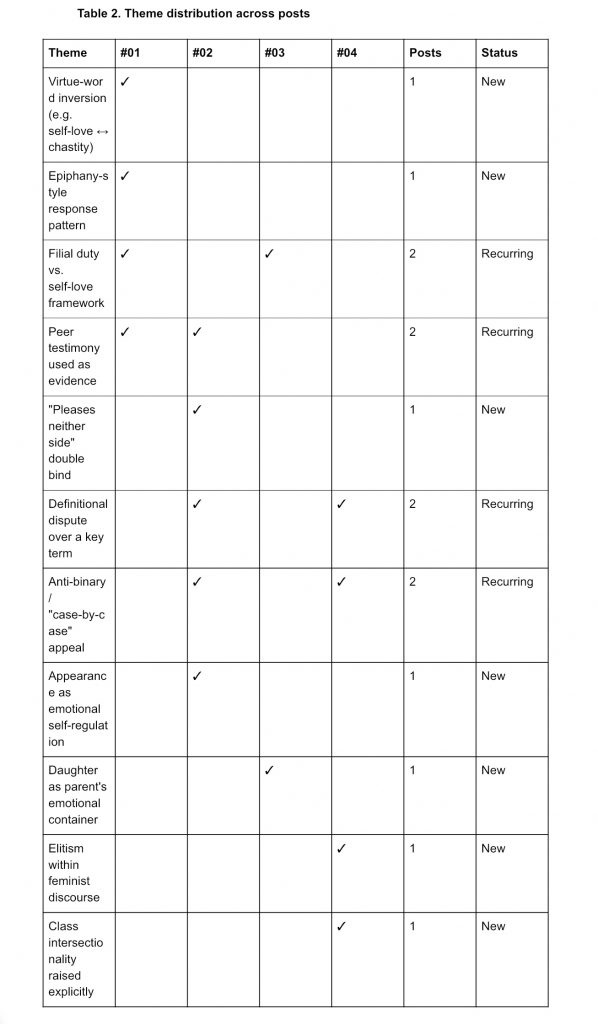
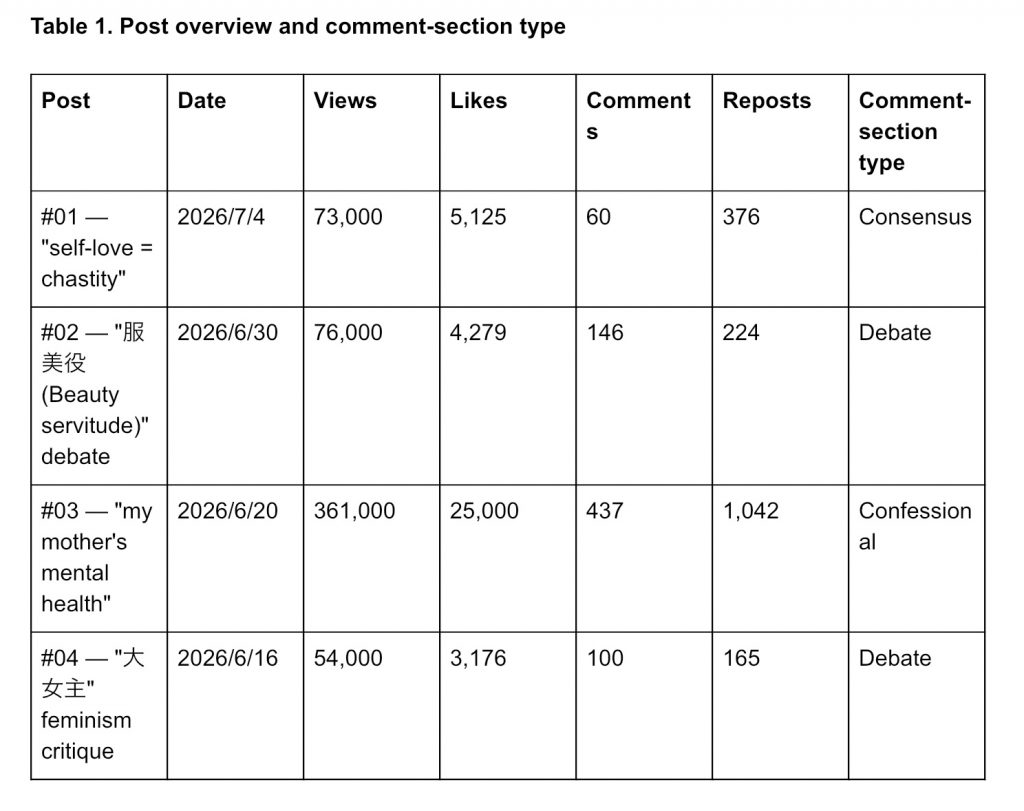
    I have collected four threads that address my research question from a range of angles, and a pattern is already harder to ignore than I expected.

    My method has been simple: collect a post and its comment section, pull out the words and phrases that keep recurring, group them into themes, then ask what each theme is doing — not just what it says, but what cultural expectation it’s quietly enforcing or exposing. What I didn’t plan for was how consistently the source of that expectation would keep moving.

    Post #01: Self-love, selfish or chastity

    The core argument of Post #01 is:

    What Chinese culture calls “self-love” is really chastity, and what it calls “selfish” is the real self-love.

    The comment section splits into two registers — short bursts of epiphany (“I get it now,” “mind blown”) and longer testimonies people volunteer about their own parents or teachers policing them with the same word. Reading Mu’s interview again while coding this, her distinction between 质 (challenging something you’ve named) and 疑 (sensing something’s off before you can name it) mapped almost too neatly onto these two comment types. The short exclamations look like 疑 snapping into 质 in real time, in public.

    Post #02: Serving or resisting patriarchy?

    Post #02 complicates that immediately. It’s a debate, not a consensus, about:

    whether things like long nails or heavy makeup count as resisting patriarchy or serving it.

    In the online culture of China, there’s a popular phrase: “服美役(Beauty servitude)”, refers to the tiring, costly labour — mainly for women — of keeping up with society’s beauty ideals. It frames endless appearance work like a form of duty or labour, driven by social and gendered expectations, not just personal pleasure.

    The author argues that many appearance‑related choices can also act as expressions of “anti‑patriarchal” resistance, and should not be simplistically labelled as “beauty servitude”.

    The poster ends up admitting she’s “两边不讨好” (pleasing neither side). That phrase has stayed with me. It’s not patriarchy versus resistance anymore; it’s two competing judgement systems, each claiming the moral high ground, and a woman caught between them regardless of what she does with her own nails.

    Post #03: Role of being a daughter

    Post #03 moves the expectation back into the family, but not in the way the original post intended. It opens asking why nobody cares about middle-aged women’s mental health, and the comments — mostly from daughters — turn it into something else: dozens of women describing themselves as:

    “我妈的女儿,我妈的丈夫,我妈的母亲”

    (my mother’s daughter, her husband, her mother)

    cycling through whatever emotional role she needs filled. It was never named as an expectation; it just kept getting handed to them.

    Post #04: Qualifications of being a feminist

    Post #04 was the one that actually shifted how I’m thinking about many things. The poster critiqued the “大女主 (dominant female protagonist)” narrative that has become popular in the country in recent years.

    whether only “大女主” (economically independent, self-made, uncompromising women) count as real feminists,

    while married women, working-class women, or anyone simply not exceptional get quietly disqualified.

    This follows the same logical trick shown in Post #01, where self-love was falsely equated with chastity. This time, the rule is no longer set by traditional patriarchy, but by a new narrative that claims to bring liberation.

    For my research, this means cultural expectations cannot be simply divided into “patriarchy versus anti-patriarchy”. Unspoken social rules can come from any group that believes it is morally correct — including feminist discourse itself.

  • Notes on Intervention

    For the current intervention, I tried two approaches using two separate Threads accounts.

    Account one was an anonymous email “树洞(tree hole: a popular Chinese‑internet metaphor. It means an anonymous online space where people share private thoughts, painful stories or secrets. Users do not reveal their real identity. )”, inviting one-on-one exchanges that could stay completely anonymous, but this risked running into parasocial boundary problems.

    Account two was a self-disclosing “hook” short text, inviting public replies visible in the comments section — I think this corresponds better to netnography.

    The problem is that both accounts have so far gotten very little response. But after comparing these two approaches — the private conversational one and the public statement one — I judged that the public “hook” short text is the direction that better fits the research design, and also does not go against the ethical boundaries I set for myself, so I will treat it as the main format going forward. So even though the intervention has not yet started working effectively, it did successfully let me find problems at the design level and make adjustments. The next step to face is how to actually get the “hooks” seen and responded to, only then can the data chain possibly begin.

  • Interview Reflection #3: Hui

    “I thought about it and realised — maybe I’m just making excuses for myself.”

    Interview reflection — July 2026

    If my conversations with Zoe and Mu were about the fracture as something named and examined through creative practice, this conversation was about the fracture as something lived — quietly, practically, and often without being noticed at all.

    Hui is 25 years old, married, with a two-year-old son. She does not make art. She speaks warmly, with humour, and with a kind of careful reasonableness that, the longer you listen, starts to feel like its own kind of management.

    The most revealing moment came not when she spoke about anything dramatic, but when she described why she is preparing for a teaching qualification. She said, almost in passing, that if she were being honest about what she actually loves, she would rather train to be a Pilates instructor. She is good at it and she enjoys it. Her fitness trainer has told her she has the right body and the right presence for it. But she is doing the teaching qualification first — because her family thinks it is more respectable. She did not describe this as a conflict. She did not pause on it. She moved straight on to the next thing. And that is precisely what made it worth stopping at: the fracture was so well-managed it had become invisible, even to her. The gap between what she wants and what she has decided is appropriate to want had already closed over, quietly, without leaving a mark.

    This pattern appeared again when she talked about expectation and disappointment. She described her approach to the qualification — and, I think, to much more than the qualification — as not wanting to hope too much, so as not to be too disappointed. I identify this as a “self-protection mechanism.” On the surface, she was talking about exam results. But the same logic was running underneath her account of her marriage. She said that having a child had made her think, for the first time, about what she would do if things fell apart — whether she could stand alone, support herself, manage without depending on anyone else. She did not say she expected her husband to fail her. She did not need to. The preparation itself said it. She is already quietly rehearsing for a disappointment she has not yet named — building the exit before she has admitted to herself that she might one day need one. This silent anticipation is its own kind of fracture: she is living in two timelines simultaneously, the one she is in and the one she is guarding against.

    There was also something I found myself returning to after the interview: her account of wanting to be with her child. She described it as something without a clear reason — just a pull, a wanting to be near him, even when other people were available to look after him. I found myself wondering where that pull comes from. Partly, it is biological — the hormonal architecture of early motherhood is real, and oxytocin does not ask for permission. But she had also told me, earlier in the conversation, that her own mother had made her breakfast and send her off to school every single day from kindergarten through high school. That memory lives in her body as warmth. She wants to give her child what she was given. So when she says she wants to be near him for no reason she can name, I am not sure the reason is absent — I think it has simply been absorbed so completely that it no longer feels like a reason. It feels like instinct. And this is perhaps the most difficult question this research keeps circling: when a woman says “I just want this,” how do we know — how does she know — whether that wanting is hers, or whether it has been handed to her so gently, over so many years, that the two have become impossible to separate?

    She also told me a story about a friend whose husband, during an argument, said: “Have you ever thought that you can buy these things because I allow it? What if one day I don’t?” She said this sentence made her feel sick. She went home and didn’t leave the house the next day. She said she rarely gets that affected by other people’s problems — but this one got through. I think it got through because it named something she already half-knew: that the permission structure inside a marriage can be invisible until suddenly it isn’t. She had spent the whole conversation describing a life she has largely made peace with. And then this story arrived, and something in her that had been carefully managed came briefly, visibly undone.

    That is the thing about the fracture. It does not always announce itself. Sometimes it arrives in someone else’s story, in a sentence spoken by a stranger’s husband, in a feeling of sickness you can’t quite explain.

  • Interview Transcript#3: Hui

    What do you feel has changed the most about you in these two years since becoming a mother?

    H: I think the first thing is my mindset. Before, I felt like anything was fine, because it was just me — I could do whatever I wanted. But once you have a family and a child, you naturally start putting him first in everything. For example, even if there’s someone at home with him at night, I still really want to get home early to be with him.

    There’s also this: before, I used to think it would be fine even if I didn’t work. But after becoming a mother, I started to feel a bit afraid of always depending on someone else in an intimate relationship. I think people can change, so there’s a little bit of fear there.

    J: Did this stronger desire for independence come out more after you had your child?

    H: Yes. Before I had a child, in a relationship, I’d think as long as it’s good right now, that’s enough — I wouldn’t think that far ahead. It’s actually because of having a child that I started to feel that even if the relationship isn’t so good later on, I still need to be capable of standing on my own.

    J: So it was actually having a child that gave rise to this idea?

    H: Yes. If it were just me alone, I think I’d feel — whatever, might as well just live freely.

    Another big change, I think, is my body. Having a child was pretty hard on my body — I get colds more easily now, my immunity isn’t as strong.

    Before and after marriage, has the way people treat you or their expectations of you changed?

    H: I think it’s actually fine. My friends might hope I stay a bit more carefree, hope that I keep my family life and my own life separate, and not lose the life I’m supposed to have just because I now have a family. But honestly I don’t feel like much has changed. The friends around me are very supportive — if anything, they keep reminding me to make time for myself.

    It’s true that I’m more focused on home now than before. Before, if we went out, even 11pm felt early and I’d still want to keep going. Now, eight or nine o’clock already feels late, and I really want to head home.

    J: If it’s already eight or nine and you want to go home but your friends want to keep going, how do you usually handle that?

    H: Usually, if it’s eight or nine, I might stay a bit longer to accommodate them, until 10. If I really want to leave that day, they can carry on and I’ll leave first.

    J: When you stay until 10 to accommodate them, do you feel a bit distracted inside?

    H: No — actually the more we talk, the more into it I get, and by the end I sometimes don’t even want to go home anymore.

    As for family, I don’t think much has changed there either — they just hope I spend more time with my child. My mum, for example, is someone with a real cleanliness obsession — she’ll insist that no matter how long he’s been out playing, the moment he comes back inside he has to be washed from head to toe. But for other things, I still mostly raise him the way I think is right.

    J: Do these kinds of instructions bring you any struggle or pressure?

    H: No. She says her thing, I do my thing. If it’s necessary, I’ll do it; if not, my mindset stays fine either way.

    Are there any ideas about how to be a mother that you grew up hearing? Which ones are you practicing now, and which ones not?

    H: My mum spent a really long time with us growing up, and I also really want to spend a lot of time with my own child, because I know what it feels like to have been accompanied like that the whole time growing up — I think it’s completely different.

    For example, there’s one thing my mum did that was really impressive: from when I started kindergarten all the way through to finishing high school, she made breakfast for me and saw me off every single day, without fail. I think that seems like a small thing on the surface, but the effect it had on me feels very different.

    But on the other hand, I don’t demand of myself that I keep him by my side all the time. I still want to have my own time — go out alone with friends when I need to, travel when I want to. As long as I feel like it’s enough in my own heart, that’s enough.

    Do you come across content from other mothers or women sharing their lives online? When you see how others are living, do you ever feel like there’s something you need to improve about yourself?

    H: Yes. When I’m scrolling Xiaohongshu, some people present themselves as having both family and career fully covered, and in those moments I do feel a bit anxious — I think, other people can do it, why can’t I.

    Or when I come across people who seem really relaxed, travelling everywhere, I also think, wow, that’s impressive. Like Lin Ruoyun — I’ll think, wow, people really can change that much. Then I start wondering about my own changes, before and after having a child, and whether I could do as well as that.

    J: It’s true that what other people post is also a very one-sided thing — it’s easy to start imagining that other people have everything figured out, just from that beautiful, one-sided glimpse.

    H: Yeah, in the moment I might compare a little. But maybe because I don’t pay that much attention to other people generally, I glance at it and then forget about it.

    You mentioned preparing for a teaching qualification — how did you start thinking about doing that?

    H: It’s because a relative of mine, who is a teacher, asked if I wanted to try getting a teaching qualification, saying being a teacher seems like a pretty good option these days. I felt like — up to now I haven’t found any job I really, truly want to do, so a teaching qualification seemed okay too, relatively stable, with winter and summer breaks, and I do like kids, so I thought I’d try it.

    But I don’t have a very strong attachment to the idea. Even if I actually pass and get certified, I might not necessarily really want to go and do it. It happened pretty suddenly, without a lot of thought behind it.

    J: Do you feel like this decision was in some way soothing a kind of anxiety?

    H: I think that’s part of it too. Maybe it’s finding something to anchor myself to at a time when I feel quite lost and aimless. Once you’re seriously doing something, the anxiety really does stop surfacing as much — you feel like you’re not so useless, like you’re doing something real every day.

    While preparing for the qualification, is there a pull between “I know I should prepare properly” and “I don’t really want to” at the same time?

    H: Yes. On one hand I feel like once I’ve started something, I should prepare for it properly, but day to day I also have to look after my child, so part of my energy gets pulled away.

    And I don’t know why, but I always end up imagining — this thing hasn’t even happened yet, and I’m already imagining that once I’ve achieved it, a lot of my time will get taken up by it, and the time I spend with my child will shrink, and that brings some anxiety. Then I start to wonder, is this just me making excuses in advance for not succeeding.

    J: I see — the thing hasn’t even started yet, and you’re already worrying about the new problems that will come once it’s done.

    H: Right. And I’m not doing this because I love the profession that much. If we’re really talking about love, I’d actually much rather be a Pilates instructor — I really love sports.

    It’s also maybe partly about meeting my elders’ expectations, because they still hope I’ll have a job they consider relatively respectable.

    H: So how do you deal with that kind of feeling?

    A: I just keep at it, and tell myself, let’s see if it can happen. I don’t put too much hope into it going in, so if it works out, it feels like an unexpected bonus, and if it doesn’t, I can accept that calmly too.

    H: Do you think that mindset can feel a bit like weakness sometimes?

    A: Yes — because you know you’re not necessarily going to succeed at this, so you also feel it’s fine if you don’t. When I see people who say very firmly, “I’m definitely going to make this happen,” I really admire that. I think if you really hold that kind of conviction going into something, you can pretty much achieve anything. I guess this is also a kind of self-protection mechanism for us — habitually protecting ourselves, preparing for the worst outcome in advance, so we don’t end up with as much disappointment.

    You mentioned once that women shouldn’t rely only on other people — where does that idea come from?

    H: I think it could partly be the influence of the rise in female consciousness in recent years. But personally, I also feel that — it’s been so long, men and women as two sexes have such a long history, and the whole system is just set up this way: men working outside the home makes more sense in some ways, women are more suited to being with children. A mother carrying a child — there’s naturally some logic to that too, that the mother is more suited to that role of being with the child.

    J: Do you feel like that view contradicts the idea that women shouldn’t rely only on others?

    H: It doesn’t contradict it. You can be more suited to being with the child, but at the same time you still need to have the ability to be independent — you can’t completely depend on someone else.

    About a friend’s story

    J: You mentioned earlier that women shouldn’t rely only on others — is there an example close to you that really affected you?

    H: Yes. I have a friend who’s pregnant, about to give birth — next week, actually. She and her husband got into an argument over some pots hanging in the kitchen. Her husband is tall and kept bumping into them, even though he barely goes into the kitchen more than a few times a year. One time he bumped into them again, got angry, and asked her why she bought so many things, why she didn’t put them away properly. Her husband told her, those things are supposed to be for my convenience, not yours. Then he threw everything off the shelf, all of it.

    And then he said something I found really disgusting. He said: “Have you ever thought about it — right now you can buy these things because I allow it? But what if one day I don’t let you?”

    J: How did that sentence make you feel?

    H: I found it really disgusting, and really sad. And I’d always had a good impression of this man — I thought he was family-oriented, patient, good to his wife. But once he said that, I felt such a huge gap open up, I felt really disappointed in human nature. I was in a bad mood the whole way home that day, and I didn’t leave the house at all the next day, just stayed in and lay around. I rarely get this affected by something happening to a friend, but this one really got to me.

    She also told me that before they got married, he was very patient with her. After she had the child, she’d toned down her own temper a lot, become much gentler — but he went the opposite way.

    J: It’s like men always save their worst side for the people closest to them.

    H: Right, I really don’t understand what’s going on in their heads. The person you’re supposed to treat with the most patience — and instead you treat them with the worst attitude. I really hate that kind of thing.

    If you didn’t have to think about your current roles, real-world constraints, or the expectations of people around you at all, how would you plan the next year?

    H: I’d want to get the teaching qualification done first. After that, I really would like to go and get a Pilates instructor certification too.

    J: If your family had never brought up the teaching qualification in the first place, would you still want to pursue it?

    H: I think they just gave me a suggestion, but personally I felt like, why not give it a try. As for Pilates — that’s because I take fitness classes, and my fitness trainer thinks I have a good body and clear muscle definition, and suggested I try to get certified. He said other people might not necessarily care how professional you are — they might just think, if this instructor can manage themselves this well, they can probably manage me well too. I feel like having one more skill isn’t a bad thing.
  • 0817 Tutorial notes w/ David

    1. Literature Review: Let the data talk with existing research

    There is now enough data, and the next step is to do a literature review — line up what you’ve found against existing literature:

    • Can existing literature support your findings?
    • Or have you found something that isn’t in the literature? This is exactly your research’s unique contribution.

    2. Intervention Strategy: Penetrate existing communities

    The current problem with the intervention: there isn’t time to build a new community for the intervention to take effect. There are two directions for a solution:

    • Penetrate existing communities: find posts that are already discussing related topics, step in through the comment section, and invite people to your space
    • Ask more directly: throw the question directly at the audience within your own posts

    Specific strategy:

    • Find the most actively engaged posts in your netnography data
    • Comment under those posts, and guide the audience toward your content
    • Write one post for each of the four core themes: self-love vs. selfishness, submitting to or resisting patriarchy, the daughter–husband–mother role, and the qualification to become a feminist

    3. Why your current posts haven’t triggered responses

    The problem is: what you’re writing are declarations, not invitations. The most effective posts:

    • Show vulnerability, so others can feel empathy
    • Leave a question and space, so others have something to say
    • Aren’t too academic, so ordinary people can also enter into it

    Comparing this to the posts in your data that triggered a lot of discussion — what they have in common is that they touched some real, not-yet-named feeling, and then left space for people to respond.

    4. Four core findings from the thematic analysis

    ① Self-love vs. selfishness: There is a shift between the word and its meaning. This shift itself is the object of analysis. Why do they need to wrap a stigmatized behavior in a “nice-sounding” word?

    ② Submitting to or resisting patriarchy: In conversations where women discuss patriarchy, men are usually absent. Many men don’t even know these conversations exist. This means patriarchy is also splitting apart the relationship between men and women — this fracture goes both ways.

    ③ The daughter–husband–mother role: David thinks this is the most uniquely valuable finding. He connects it to Attachment Theory:

    • Secure attachment: when the mother leaves and comes back, the child calms down immediately
    • Anxious attachment: the child clings tightly to the mother and won’t let go (afraid of being left again)
    • Avoidant attachment: the child ignores the mother’s return (has already learned not to depend on her)

    When a daughter is forced to take on the role of “husband” and “mother,” her developmental needs are not met — this could affect her attachment patterns later on in intimate relationships. Suggestion: add this direction into the literature review.

    ④ The qualification to become a feminist (David thinks this is the most powerful finding): “Unwritten social rules can come from any group that believes it holds the moral high ground — including feminist discourse itself.” Patriarchy is not the only “monster.” Feminist discourse, in certain situations, can also become an invisible qualification-screening system.

    5. Clarifying the Blog and Report relationship again

    • Blog = digital notebook, the raw repository of all your research, no word limit
    • Report = distilled from the blog’s most important content, organized according to the learning outcomes framework (Inquiry → Knowledge → Process → Communication → Realization), has a word limit
    • Blog as the report’s appendix: any interviews, screenshots, or analysis mentioned in the report should have a link pointing to the corresponding page on the blog

    Suggestion: turn the interview recordings into English subtitles or an English transcript and upload them to the blog, and highlight the key passages you quote in the report, so they’re easy to locate quickly.

  • Participant Information sheet

    Participant Information Sheet

    参与者信息说明

    Project title: No One to Blame (working title)

    MA Applied Imagination, Central Saint Martins, University of the Arts London

    项目名称:No One to Blame(暂定)|伦敦艺术大学中央圣马丁 MA Applied Imagination

    1. About me  /  关于我

    My name is Jingzi Zhang (Jing). I am an MA Applied Imagination student at Central Saint Martins, University of the Arts London. My tutor for this project is David Mills You can contact me at j.zhang0720251@arts.ac.uk.

    我是 Jingzi Zhang(Jing),伦敦艺术大学中央圣马丁 MA Applied Imagination 的学生。本项目的导师是 David Mills 。你可以通过j.zhang0720251@arts.ac.uk 联系我。

    2. What the project is about  /  项目内容

    This project looks at the gap between how young Chinese women feel and what cultural expectations ask of them. It asks whether making that gap visible on social media can help expose those expectations. There are no right or wrong answers. I am interested in your own experience and how you see it.

    这个项目关注年轻中国女性真实的感受与文化期待之间的落差,并探讨在社交媒体上让这种落差被看见,是否有助于让这些期待显现出来。没有对错之分,我更关心你自己的经历和看法。

    3. Why I am asking you  /  为什么邀请你

    I am inviting you because you are a young Chinese woman aged 23–28 . Your experience is valuable whether or not you have thought about these topics before.

    邀请你是因为你是 23–28 岁的年轻中国女性。无论你之前有没有想过这些问题,你的经历都很有价值。

    4. What taking part involves  /  参与内容

    One conversation of about [45–60] minutes, in Chinese or English, in person or online. With your permission I will make an recording. You can skip any question, take a break, or stop at any time.

    一次约 [45–60] 分钟的交流,可以用中文或英文,线下或线上进行。经你同意,我会进行[录音 / 录像]。你可以跳过任何问题、随时休息或中止。

    5. How your words will be used  /  你的内容如何使用

    I will transcribe the recording and, where needed, translate it into English. Short quotes may appear in my MA report, in presentations, on my research blog and possibly in a zine. I will use a pseudonym and remove details that could identify you, such as your workplace, your city or the names of family members. Please note that presentations and the blog can be read by other people. I will show you any quotes before they are published so that you can approve or change them.

    我会将录音转写,必要时翻译成英文。简短的引用可能出现在我的 MA 报告、展示、研究博客,以及可能的 zine 中。我会使用化名,并删除可能识别出你的信息,例如工作单位、所在城市、家人姓名。请注意,展示和博客可能被其他人看到。引用发布前我会给你确认,你可以同意或修改。

    6. Keeping your information safe  /  信息保管

    Recordings and transcripts are stored on a password-protected device. Only I, and my tutors where required for assessment, will have access to the full material. I will delete the recordings after the course ends (06/12/26).

    录音和转写稿保存在有密码保护的设备。只有我本人,以及评估需要时我的导师,可以看到完整材料。录音将在课程结束后(06/12/26)删除。

    7. Taking part is voluntary  /  自愿参与

    You do not have to take part. You can withdraw at any time until [28/08/26] without giving a reason, and I will delete your material. After that date, material already used in assessed work or already published may not be possible to remove.

    是否参与完全由你决定。在[28/08/26]之前,你可以随时退出,无需说明理由,我会删除你的材料。此日期之后,已经用于评估或已发布的内容可能无法撤回。

    8. Possible risks and support  /  可能的影响与支持

    Some questions, for example about family or expectations, may bring up strong feelings. You can pause or stop at any time. I am a student researcher, not a counsellor, and I cannot offer ongoing personal support after the conversation. If you would like support, you could talk to someone you trust or use: [Chinese Mental Health Association(CMHA): 020 7613 1008 ].

    有些问题(例如关于家庭或期待)可能引起强烈的情绪。你可以随时暂停或停止。我是学生研究者,不是心理咨询师,交流结束后无法提供持续的个人支持。如果你需要支持,可以和信任的人聊聊,或者联系:[心理援助热线: 12356/妇女维权热线: 12338 ]。

    9. Questions or concerns  /  疑问与顾虑

    If you have questions, please contact me. If you have a concern you would rather not raise with me, you can contact my tutor.

    如有疑问,请联系我。如果你有不方便直接对我说的顾虑,可以联系我的导师。

    10. Consent  /  同意

    If you are happy to take part, I will ask you to sign a consent form, or to give your consent on the recording. 如果你愿意参与,我会请你签署同意书,或在录音中口头表示同意。