Could you briefly introduce your current art practice? How do you define yourself within the art world?
Z: My work right now is mainly built around moving image, theatre, and publishing. But more than the practice itself, what I’m really interested in is how perception is constructed — how, in unfamiliar, unbalanced, or high-pressure environments, the body starts to change the way it sees, moves, and understands the world.
Z: A lot of my work doesn’t start from a story. It starts from a bodily state — suppressed, exposed, waiting, alert, or off-balance — and then it gradually develops into a space, a story, or something between sound, image, and text.
Z: If I had to define myself, I’d say I’m an artist whose core is bodily perception. For me, moving image isn’t a technique, and theatre isn’t a narrative structure — they’re more like ways of letting the audience enter a certain space. A means of communication.
J: I really like your use of the word “construct.” So you’re using the context behind emotion and movement to shape your creative approach?
Z: Yes. Basically the starting point of all my work comes from my own bodily perception.
In your creative work, is there something you keep coming back to, keep questioning?
Z: I keep thinking about the relationship between the body and consciousness. In my earliest sense of it, they coexist — but I’ve found that the body remembers trauma, power dynamics, and fear earlier than consciousness does, even things we think we’ve already forgotten.
Z: A lot of the time we think we’ve moved past an uncomfortable memory, but the body still holds an unconscious response to it — it can be reactivated in a certain kind of intimacy, a certain space, a certain sound or light. So I keep asking: why can my brain have already forgotten something, while my body responds first?
J: It’s true — the body’s response can come faster than thought. It’s itself a very important kind of evidence.
Z: Right. So “perception” isn’t a neutral word for me. How a person sees others when they enter a space, how they’re seen — all of that is tied to their upbringing, emotional structure, and power relations.
If you had to choose one keyword for your artistic personality between “questioning” and “reconciliation,” which would you pick?
Z: This question is hard for me to answer directly, but I’d lean toward “questioning.” My work rarely offers an answer — it’s more about continually taking apart structures that seem self-evident: intimacy, family, seeing and being seen, or love.
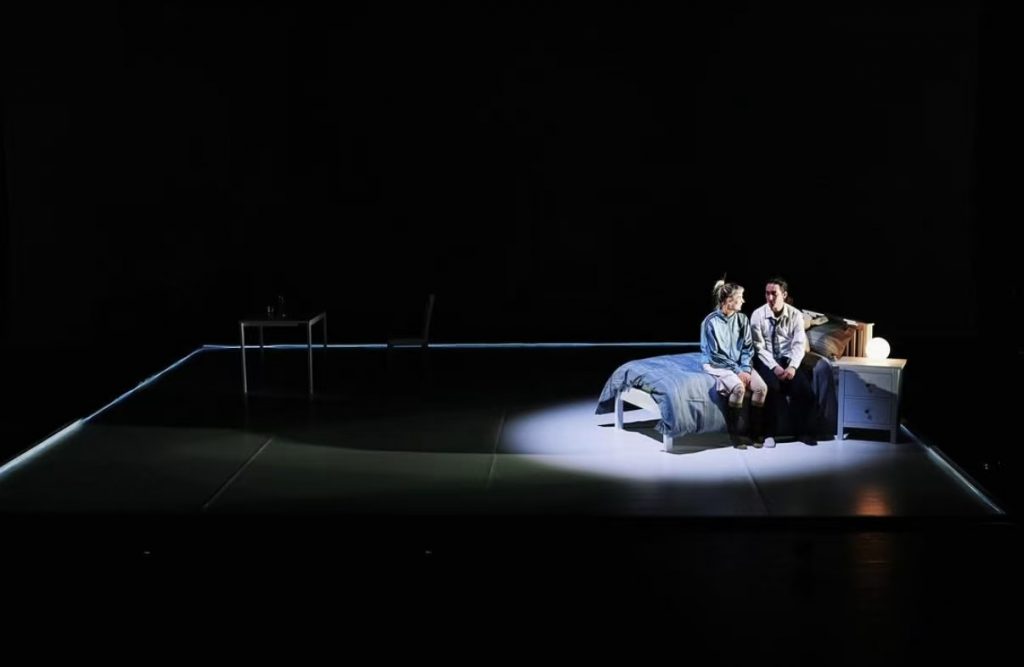
Z: For example, in the contemporary dance-theatre piece we made this year, Metomodeline, the audience at first thinks they’re watching an ordinary intimate relationship. But as the piece progresses, that relationship gradually turns into a power mechanism, then loops back into the repetition of trauma, until by the end, when the stage is completely exposed, the intimate relationship is no longer a private experience — it becomes more like a publicly operating system.
Z: So I can’t answer this question with a ready-made answer. At the very least, I want people to remember: you have the right to choose — the right to choose reconciliation, and of course also the right to keep struggling between questioning and reconciliation.
J: So for you, the process of exploration in the work matters more than arriving at a conclusion?
Z: Yes. Even by the end of a piece, you don’t need to give a black-and-white answer. It can stay ambiguous.
How do you feel about the idea that “art should be honest to oneself”?
Z: I partly agree. “Honesty” here doesn’t directly mean exposing your private experience to the audience or curators. Real honesty is more like a positioning of perception — whether I’ve actually faced my own fears, desires, contradictions, or shame, rather than packaging them into something more palatable.
Z: A lot of the time, “dishonesty” in art isn’t lying — it’s more like over-explaining. And art doesn’t necessarily correspond directly to the real self — art isn’t my instruction manual. It’s the mechanism by which I turn things I can’t say out loud into space, rhythm, sound, or image. Only after that transformation can it really be perceived. But the process of transformation always involves some polishing and exaggeration, so in that sense it does drift from what we’d originally call “honesty.”
J: Like how language itself distorts things in the process of being conveyed — that’s just an objective condition.
Z: Right. So I think sometimes that involuntary “dishonesty” is, in a way, a form of honesty.
Does your family understand your art practice? What’s their attitude toward it?
Z: My family knows I make art, but they don’t really know what exactly I do, and they don’t really understand it — especially since a lot of my work leans toward experimental moving image and conceptual theatre, which is quite far from art in the traditional sense. My parents are more in a state of “they’ve run out of options, but they just have to accept it.” My work is actually fairly foreign to them.
J: That’s interesting — family is supposed to be conceptually the closest to you, but sometimes they end up being the group furthest from your artistic self.
Z: That’s exactly right.
As a Chinese woman artist, have you felt a kind of double consciousness — between what you want to express without filtering, and some kind of external expectation placed on you? Is there a fracture between the two?
Z: Yes, and it’s quite obvious. On one hand, I have a strong impulse to directly present the bodily experience, vulnerability, desire, and fear I want to express.
Z: But on the other hand, I’m also very aware that the outside world’s gaze on Chinese women often comes with presets — they might want us to be more restrained, gentler, more “understandable,” or alternatively more dangerous, more out of control. Some artists go along with that; some do the exact opposite.
Z: For me, both perspectives exist at the same time: on one hand I have to explore what I’m actually looking for, and on the other hand I also have to watch how others will perceive my expression. A lot of my work is exactly the result of these two forms of consciousness continually colliding.
J: Making work in London probably makes that pressure even more complicated — there’s both the gaze from a Chinese perspective and the West’s expectations of a Chinese woman artist.
Z: Yes. There’s a very particular feeling within that double gaze. But I don’t think I need to create for the image of the “Eastern artist” that people expect — that’s not what interests me. And because China is such a vast country, everyone’s upbringing is completely different, so I don’t need to force myself to fit into things I don’t actually connect with.